Case Study
Viet Nam: Tan An City, Long An Province
WWF Involvement: August 2020 to July 2021
Focus Area: Collection
PSC Approach: Formal Collection
Systemic Intervention: Systems and Infrastructure
© APEC Singapore
Key Lessons Learned
- Separating wet and dry waste significantly improves overall material recycling: This is the first step to enhancing the quality of both organic and recyclable fractions, notably increasing overall material recycling.
- Integrating informal workers into the formal waste management system supports a just transition: While the recycling of dry recyclable materials was limited in this instance, the informal waste sector plays a critical role within the solid waste management (SWM) system. Integrating informal workers into formal waste management structures can help capture more recyclables and ensure a just transition for these workers. This provides them with a stable income and social protection, strengthening both social equity and recycling outcomes.
- Regular monitoring and visible feedback mechanisms encourage sustained waste separation behaviours: Continuous waste segregation monitoring by waste collectors, combined with real-time feedback significantly improved household participation in waste separation. Providing households with visible evidence – such as seeing their organic waste converted into compost – reinforced trust, strengthened engagement, and supported lasting behavioural change.
Background
Viet Nam is a major contributor to marine plastic pollution, with the Mekong River serving as a significant pathway for waste entering the oceans (Pfaff-Simoneit, 2023). Tan An city, located in the Mekong Delta, was selected as a pilot area to address these challenges.
Waste collection systems in Long An Province are still in the process of being strengthened, particularly in rural areas. According to Pfaff-Simoneit (2023), around two-thirds of the population have access to regular waste collection services. In areas where formal infrastructure is not yet fully established, unmanaged disposal practices, including open dumping on land and into water bodies, continue to occur.
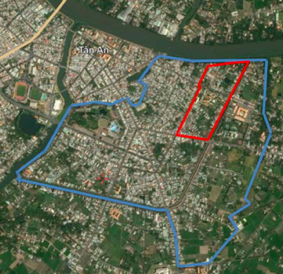
Separation at source and low-tech waste collection were introduced to capture organic, recyclable, and residual wastes, turning them into marketable products to reduce waste sent to landfill. Ward 3, in Tan An, covering a population of 16,618, was selected for the pilot.
Objectives
- Introduce a reliable and user-friendly separate waste collection system for organic, recyclable, and residual wastes at the household level.
- Implement a labour-intensive, low-tech waste collection system designed to enhance the quality and recycling of recyclable materials and create employment opportunities.
- Assess cost and revenue to determine whether high collection costs can be offset by revenues and cost savings, particularly reduced landfill expenses.
- Promote behavioural change among households to ensure waste source separation.
Key Successes
- High organics recovery rates: The separate collection system recovers 80% of organic waste from households, with less than 1% contamination, producing high-quality compost and increasing landfill diversion.
- Environmental, social, and economic benefits: Compost made from organic waste, invasive water hyacinths, and agricultural straw – which is usually openly burned – is quality tested and utilised by farmers. This compost replaces chemical fertilisers, which are more affordable and improves crop yields.
- Cost recovery: The sale of compost at the local market covers the costs of collection worker’s salaries and the purchase of new waste processing equipment. It is also projected that scaling the project to the city level in Tan An would yield cost reductions of 30 to 35% through economies of scale for the municipality (Pfaff-Simoneit, 2023).
- Local Government Scaling Efforts: The People’s Committee of Tan An City is assigned to continue waste separation in Ward 3 and develop a plan for citywide expansion. While the Department of Natural Resources and Environment is tasked with overseeing implementation in other districts.
- Behavioural change: Within two weeks, over 90% of households in the pilot area complied with separation at source practices, up from 33% at the start, due to monitoring conducted through household inspections by waste collectors, waste composition tracking, and interviews with residents and waste collectors.
Key Challenges
- Retained dry recyclable waste: Only 18% of dry recyclable waste was collected by municipal services as the rest was retained by households and given to informal waste workers. While informal sector activity is welcome, this prevented more materials to be collected through formal systems lowering the effectiveness of municipal recycling facilities.
- Limited integration of the informal waste sector: Regulatory restrictions prevented the timely inclusion of informal waste workers in the project, impacting the overall recycling of recyclable materials.
- Coconut shells account for 10% of organic waste but are not processed due to the absence of a shredder at the composting facility, coconut shells are currently redirected to the residual waste stream.
- Lower participation from non-household generators: Waste separation practices were found to be less consistent among businesses.
Resources
Support: The pilot was funded by WWF, including salaries for the collection team of 19 members, the purchase of community composting bins, collection carts, and motorised collection equipment. Additionally, WWF covered the costs of training household participants and workers in proper waste separation. There are plans for handover to local authorities for continued operation.
Human resources: All household participants of the study were trained and educated on how and why to separate waste, becoming trainers within their communities to increase capacity building and local ownership. Five waste collectors were also trained for post-sorting of household and non-household waste to improve the quality of the separated waste fractions, while also monitoring participants to ensure proper separation of organic and residual waste streams. Workers reported that their workload was manageable and not too strenuous.
Equipment: Community composting bins were provided for residents to deposit their organic waste. While collection carts equipped for on-the-spot sorting allowed waste collectors to evaluate and ensure proper waste separation at the point of collection.
Stakeholder engagement: The significant 80% increase in separation at source amongst residents was driven by the involvement of the Women’s Union and Neighbourhood Association (community-based organisation) and informative conversations between waste collectors and residents. These interactions were especially effective as residents often felt more comfortable engaging with community representatives than local government officials.
Partners: Key partners included WWF-Viet Nam (lead implementing organisation and funder), the City of Tan An (local authority), and community-based organisations including the Women’s Union and Neighbourhood Association (mobilised residents). These partnerships ensured strong institutional support, smooth implementation, and high community engagement.
Enabling Factors
Behavioural change and feedback mechanisms: Educating and training households and non-households about waste separation is fundamental. A key driver for this was continuous monitoring – waste collectors assessed sorting quality at every collection and provided real-time feedback. Engagement further increased when participants saw firsthand how their organic waste was transformed into compost. This tangible feedback loop not only builds trust but also reinforces sustained engagement and commitment to the waste separation process.
Compost quality control was required to ensure a high-quality output and instil confidence with its safety and effectiveness. The project followed a high-purity source separation model, where organic waste had less than 1% impurity (Pfaff-Simoneit, 2023). Quality control should also be maintained through regular testing.
Post-sorting quality assurance: Having workers to post-sort the pre-sorted household waste ensures high quality. Better sorted waste is also less work for the waste collectors.
Risks & Opportunities
- Possible reduction in compliance: If the quality of separation at source reduces among household and non-household generators and the waste cannot be taken directly to a composting facility, transport to transfer stations or material recovery facilities may be necessary to improve the sorting quality of collected waste. Continued engagement with the community and monitoring by local authorities could mitigate this risk.
- Local Government Support: The People’s Committee of Tan An City and the Department of Natural Resources and Environment will be responsible for the continuation and scaling of the pilot to other parts of the city and beyond. The government bodies now have the knowledge and experience to carry out this model’s expansion with potential policy enforcement for source separation.
Read more about this model here: Enhancing Labor-intensive Separate Waste Collection and Utilization in APEC Economies