Case Study
China: Hong Kong SAR
WWF Involvement: September 2022 to August 2024
Focus Area: Reduction
PSC Approach: Reuse and Refill
Systemic Intervention: Knowledge Strengthening
Key Lessons Learned
- Strong adoption and participation: More than 27,300 reusable containers were dispatched to customers between October 2022 and July 2024, with over 17,000 food orders placed using reusable packaging. The initiative engaged over 80 restaurant partners and reached more than 15,400 consumers, with a 25% monthly reorder rate, indicating repeat user engagement.
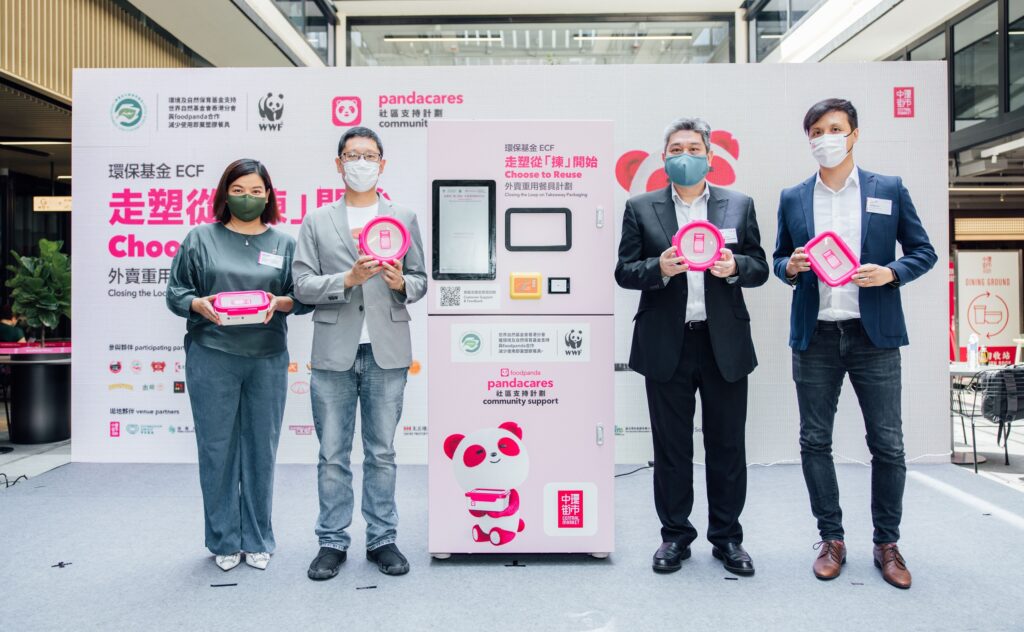
- Expansion of infrastructure and logistics: The project started with nine collection machines in high-foot traffic areas and later expanded to 12 locations, covering a 6 to 7 km radius. Reverse vending machines were integrated with the city’s Octopus e-payment system, making deposit refunds seamless. Partnerships with nine property developers and the MTR Corporation enabled strategic placement of collection points.
- Effective awareness campaigns: Exposure via foodpanda channels, as well as advertisements at MTR stations, and commercial buildings helped raise awareness. Public and corporate workshops, along with collaborations with influencers and environmental advocates, played a key role in increasing consumer interest. The initiative is also aligned with the Sustainable Restaurant Certification Scheme to promote adoption among businesses.
Background
Hong Kong has faced growing plastic pollution challenges, exacerbated by the increasing popularity of food delivery services. The surge in SUP packaging, particularly during the COVID-19 pandemic, highlighted the urgent need for sustainable alternatives. In response, WWF-Hong Kong partnered with foodpanda Hong Kong to introduce a closed-loop reusable container system for delivery and takeaway meals.
This initiative aligns with Hong Kong’s Waste Blueprint for 2035 (Environment Bureau, 2021) and supports the PSC approach, both aimed at reducing plastic waste and promoting sustainable urban solutions.
Objectives
- Enhance consumer awareness regarding reusable food packaging.
- Promote behavioural shifts to reduce reliance on SUP.
- Develop a scalable logistics model for reusable food containers.
- Encourage the food and beverage industry to adopt sustainable packaging solutions.
Key Successes
- Plastic-free canteen: The school eliminated single-use plastic by enforcing reusable lunch boxes and cutlery, reducing waste. Any leftover food was given back to the external food vendors to dispose offsite.
- There is minimal waste generation, so only two source separation bins are necessary (organic and paper). Organic, paper and cardboard waste are composted, recycled or used in upcycling projects – where students transform paper and cardboard waste into culturally significant artwork, preserving and celebrating their heritage.
- Student empowerment: A rotating “captain of the day” system encourages students to oversee waste management, instilling responsibility.
- Integration of zero waste and environmental education into the school curriculum, ensuring long-term impact.
Key Challenges
- Engagement levels evolved over time: While initial participation was strong, engagement began to taper after six months. This shift appeared to be influenced by challenges in expanding restaurant involvement, a more limited selection of menu offerings, and reduced visibility on the delivery platform.
- Return rates were lower than initially anticipated: The use of a HKD 10 deposit provided some incentive for returns; however, it was not always sufficient to encourage timely container recycling. Although foodpanda offered incentives to couriers to support returns, some users preferred to return containers in bulk or chose to retain them for personal use, which impacted overall return rates.
- Sustaining financial viability required ongoing investment: The initiative involved costs across several operational areas, including logistics, industrial cleaning, marketing, and container maintenance. In the absence of regulatory incentives or external subsidies, maintaining these functions presented considerations for long-term scalability and financial sustainability.
Resources
- Support: Together with foodpanda Hong Kong, WWF led stakeholder engagement, project coordination, and public outreach, with the objective of integrating reusable packaging into the food delivery system. WWF secured financial support through the Environment and Conservation Fund (ECF) and ran awareness campaigns to drive consumer and business participation. The initiative’s setup and operational costs included USD 5,000 per collection machine, with a monthly rental fee of USD 450 per location. Logistics for cleaning and transportation totalled USD 10,000 per month, while reusable containers were procured at USD 2 per unit, with contingency stock to maintain availability.
- Stakeholders: Financial backing from the ECF, WWF partnered with foodpanda Hong Kong and over 80 restaurant partners, as well as property developers and the Mass Transit Railway (MTR). Logistics and cleaning operations were managed by The Society of Rehabilitation and Crime Prevention (SRACP)’s social enterprise, Bright Services Co. Ltd., while Gategroup Solutions Hong Kong Limited managed sanitisation and redistribution, ensuring a seamless return process.
- Human resources: A part-time WWF project manager oversaw implementation, logistics, and stakeholder coordination. Additional support staff were assigned by foodpanda to manage operations, customer engagement, and container collection at return stations.
Enabling Factors
- User-friendly system: Return stations are simple, intuitive and easily accessible to encourage participation.
- Strategic machine placement: Locations with high foot traffic, such as transit hubs and office complexes, ensured better return rates.
Risks & Opportunities
- Scaling efficiency: Some restaurants and food delivery platforms may be hesitant to adopt reusable systems due to perceived complexity and limited short-term financial returns. Stronger reuse policy could see reuse systems to be adopted more widely to ensure financial sustainability due to the model’s dependence on economies of scale.
- Sustaining public engagement: Ongoing consumer participation may require continuous investment in marketing and education efforts by both local governments and private sectors.