Case Study
Viet Nam: Hue
WWF Involvement: November 2021 to December 2024
Focus Area: Reduction
PSC Approach: Reduction; Reuse/Refill
Systemic Intervention: Knowledge Strengthening
Key Lessons Learned
- Economic incentives support long-term success: Securing financial commitments from stakeholders, including government agencies and the private sector, helps ensure sustainability over time.
- Practical and affordable alternatives facilitate wider adoption of sustainable practices: Businesses are more inclined to shift toward sustainable practices when cost-effective and practical alternatives to SUPs are readily available. Demonstrating successful case studies and best practices further builds confidence among businesses and encourages broader uptake.
- Maintaining public infrastructure: Public awareness campaigns accompanying infrastructure installations encourage correct usage and ongoing maintenance. Clearly defined management responsibilities and consistent funding for the upkeep of infrastructure — such as water refill stations — are important for ensuring lasting operational effectiveness.
- Reliable impact measurement strengthens scalability and stakeholder confidence: Implementing robust monitoring frameworks that accurately measure plastic waste reduction can refine strategies and support informed decision-making. Data-driven insights clearly demonstrate effectiveness, encouraging stakeholders to support and replicate successful models.
Background
According to the 2021 baseline assessment carried out by WWF in Hue city, 15% of the total waste generated in the city was plastics (60 tonnes/day). The assessment also highlighted interventions to improve the overall SWM system (WWF , 2024e).
Since 2022, PSC in Hue has worked at the provincial level with Thua Thien Hue Province Tourism Department and Association to promote the reduction of SUP in the tourism sector. The programme supported the development and implementation of several Plastic Waste Reduction Tourism Models: a community-based Tourist Destination Model in Thuy Bieu Village, a Plastic Waste Reduction Hotel Model, and a Pilot Model for Teaching and Training a Plastic Waste Reduction-Oriented Workforce.
Objectives
- Educate and engage tourism businesses in implementing business practices, such as reducing the use of SUP.
Key Successes
- Pro-active engagement from Thua Thien Hue Province Tourism Department and Association.
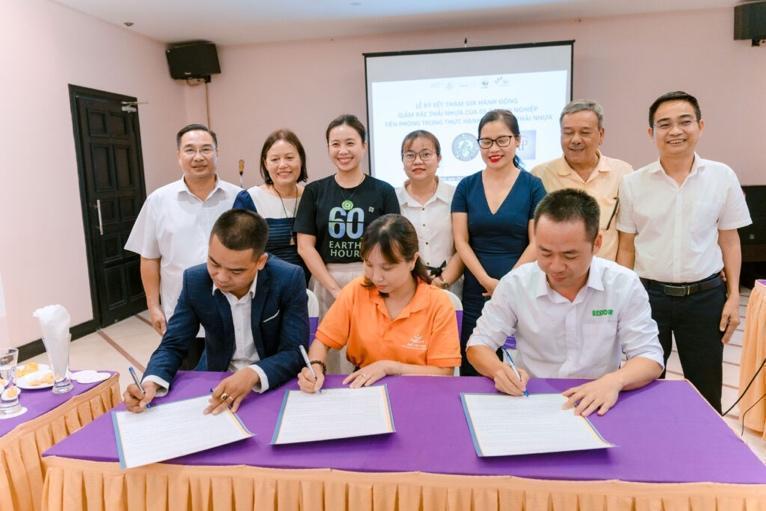
- Over 40 tourism businesses, including hotels, tour companies, and restaurants have signed a commitment to implement plastic waste reduction in their operations. In the first three months of 2024, four partnered tour companies reduced more than 3,300 water bottles.
- Nine tourist destinations in Hue city have installed water refill stations, including the Thien Mu Pagoda, Bao Vinh Ancient Town, Half-Moon Bridge, Vong Canh Hill, and Sinh Village.
- 12 hotels have developed and are implementing a grassroots plastic reduction plan.
Key Challenges
- Financial constraints in reducing SUPs: Businesses may face challenges in transitioning away from SUPs due to the relatively high cost of sustainable alternatives. Without access to financial incentives or external funding, many hesitate to adopt environmentally friendly practices.
- Business engagement remains a work in progress: Many businesses are still navigating how to align plastic waste reduction efforts with their operational and financial priorities. The availability of economically viable alternatives that meet business needs continues to evolve, and finding the right balance between environmental goals and profitability remains an ongoing consideration.
- Sustaining public water refill stations presents operational considerations: Public water refill stations and waiting areas at tourist sites have experienced wear and tear, influenced in part by varying levels of public understanding regarding shared resource care. Ensuring consistent funding for ongoing maintenance and operations is also important to support long-term effectiveness and the potential for broader replication.
- Assessing long-term impact is still evolving: The contribution of these initiatives to overall plastic waste reduction is not yet fully clear, as existing monitoring is based on peak-week observations (i.e. weeks where the most waste is generated). Broader data collection would support a more complete understanding of progress over time.
Resources
- Support: WWF supported collaboration between all stakeholders and ensured political buy-in. They provided equipment and facilities for Hue City to promote the efficiency of waste collection and separation at source.
- Partners: Thua Thien Hue Province Tourism Department and Association, Party Committee of Hue City, Community Tourism Sub-Association, Green Park Centre’s Hue City People’s Committee, Hương Vinh Ward People’s Committee, Phu Mau Commune People’s Committee, travel tour agencies, hotels, and restaurants.
Enabling Factors
- Political endorsement: A clear showcase from the municipality’s support and recognition of the city’s commitments to tackle tourism waste encourages a sense of moral value among the partners but also reinforces their dedication to reducing plastic waste and inspires others to join the initiative.
- Increased awareness: The growing awareness from business owners and consumers of the negative impacts of plastic waste can help ensure they remain committed to plastic waste reduction.
- Demonstrated success: Potential new partners are more likely to shift their business models if successful experiences can be demonstrated.
Risks & Opportunities
- Availability of cost-effective alternatives: Alternatives to SUP tend to be more costly for businesses. If financial incentives or regulatory pressure decrease, corporate participation may be affected over time. Businesses and the tourism department could collaborate with one another on reuse models or bulk purchases of alternative materials to lower costs.
- Scaling nationally by replicating the model with other provincial tourism departments and businesses could increase the impact of this initiative.
Read more about this model here: The Plastic Reduction Journey of Hue City