Case Study
Thailand: Hat Yai, Koh Samui, Songkhla, Surat Thani
WWF Involvement: March 2024 to December 2024
PSC Approach: Reduction and Reuse/Refill, Sustainable Alternatives
Focus Area: Reduction
Systemic Intervention: Knowledge Strengthening
© WWF-Thailand
Key Lessons Learned
- Consistent and targeted communication to increase customer engagement: Clear, ongoing communication that addresses both long-standing and new customers helps businesses effectively convey the purpose and benefits of PACT initiatives, while navigating varied customer expectations.
- Highlighting cost savings and market benefits drives business participation: Businesses are more likely to join and remain committed to PACT when tangible operational cost reductions and additional market advantages, such as enhanced tourism appeal and increased customer satisfaction, are evident.
- Consumer preferences significantly influence adoption of sustainable practices: Eco-conscious customers actively reinforce businesses’ commitments by consistently choosing sustainable options. However, continued consumer awareness efforts are still very much needed.
- Strong local leadership and community engagement increases programme effectiveness: Local governments play a vital role in connecting businesses to PACT initiatives, while effective leadership from trusted community figures – with strong communication skills and the ability to build relationships – highlights deeper commitment and stakeholder buy-in.
- Continuous consultation and peer learning enhances long-term business commitment: Regular opportunities for experience-sharing, ongoing workshops, and practical demonstrations encourage businesses to remain engaged and consistently implement plastic waste reduction strategies.
Background
WWF’s Plastic ACTion (PACT) is a business initiative that aims to reduce waste and move towards a circular economy. The programme empowers companies to adapt their business models and processes to be more resource efficient, as WWF facilitates the coordination of businesses in the HORECA (hotels, restaurants, cafes) sector and takeaway platforms. The PSC project further contributed to raise awareness among tourists, residents, youth, and business owners.
In 2020, the Plastic Institute of Thailand estimated that 36% of the 9 million tonnes of plastics produced annually are single-use plastics (SUP) (EJF, 2024), 15% of which ends up in the environment, having a negative impact on the natural ecosystem and the tourism industry. To tackle the use of SUP in the hospitality sector, WWF-Thailand piloted the PACT initiative with 38 local businesses in Koh Samui, Songkhla, Surat Thani and Hat Yai. Specifically service providers, such as food delivery companies, which influences consumers and merchants across the country. These platforms have actively contributed to the PACT initiative through business partnerships by implementing several key strategies as follows:
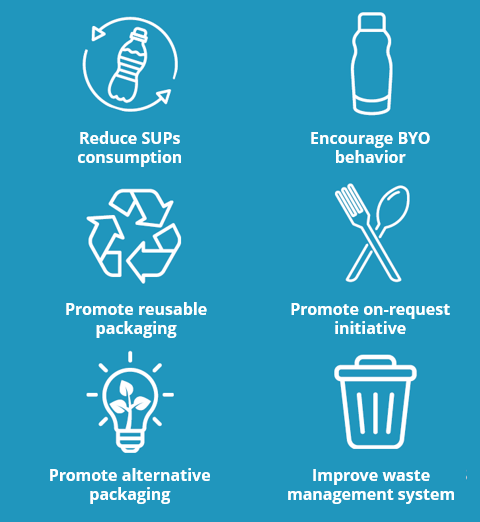
- Reduction of SUPs: The companies have introduced an “opt-out” feature for plastic cutlery in their applications, encouraging customers to decline unnecessary utensils.
- Promotion of sustainable materials: They are advocating for the use of eco-friendly and reusable packaging among their partner restaurants and are collaborating with major packaging suppliers to facilitate this transition.
- Information sharing and best practices: These service providers are sharing relevant information, case studies, policies, and best practices to facilitate business transition toward circularity.
Objectives
- Encourage businesses to adopt eco-friendly business models.
- Promote consumer behaviour changes to reduce SUP packaging.
- Provide businesses with tailored monitoring and evaluation tools and training, communication for behavioural change, guidance, best practices, and network building among stakeholders in the value chain.
Key Successes
- In one month, 10,000 applications were received from businesses throughout Thailand to join PACT for alternative plastic packaging materials.
- Between April and December 2024, 67,000 businesses have joined PACT through LINEMAN Wongnai, contributing to a reduction of an estimated 33 tonnes of SUPs.
Key Challenges
- Business engagement: Some businesses were initially hesitant to join the PACT campaign, particularly where awareness of sustainability practices or environmental commitments was still emerging.
- Customer engagement: Certain customers expressed dissatisfaction when single-use plastics were not readily available, especially where convenience or hygiene was a concern.
- Municipal engagement: Municipalities demonstrate varying levels of engagement with plastic reduction efforts. Where municipal leadership is more proactive – such as in Surat Thani – positive outcomes have been observed through stronger collaboration with the HORECA sector.
- Financial costs for SUP alternatives: The cost of sustainable packaging can be a barrier. For example, sugarcane bagasse containers for takeaway meals typically cost THB 3 to 6 per unit, compared to THB 1.5 to 2.5 for conventional SUP equivalents.
- Additional human resource needs: For businesses shifting to reusable alternatives, staff must manage regular washing cycles. During peak customer periods, maintaining this system can be challenging, potentially leading some businesses to revert to SUPs when under pressure.
- Need for consistent communication: Businesses often need to balance the expectations of long-standing customers with those of new ones. Some returning customers may feel uncertain about changes, while new customers may respond more positively to sustainability practices.
Resources
Partnerships: LINEMAN Wongnai, foodpanda (major food delivery platforms) and CaneX Bio-Packaging (supplier of sustainable packaging solutions).
Enabling Factors
Political endorsement: Visible municipal support and recognition of PACT commitments create a sense of shared responsibility among partners and help reinforce their dedication to plastic waste reduction, encouraging wider participation.
Partnerships with the private sector: The broad reach of the PACT initiative has been made possible through close collaboration with private sector actors, such as food delivery platforms and packaging suppliers.
Rising consumer awareness: Increasing awareness among business owners and consumers about alternatives to SUPs has played a key role in accelerating adoption of sustainable practices across Thailand.
Risks & Opportunities
- Affordability of alternatives: Alternatives to single-use plastics often come at a higher cost to businesses as well as consumers. Without ongoing financial or regulatory support, some businesses may struggle to maintain participation. Businesses could engage as a group to align on reuse or alternative materials, potentially lowering costs.
- Greenwashing risks: Some companies may appear to support sustainability while continuing unsustainable practices. As consumers become more environmentally aware, misleading claims could undermine trust and slow progress toward genuine plastic waste reduction. Alternative materials should be carefully considered by businesses to ensure there are no additional harmful environmental impacts.
For more information on PACT and for contact details to join the initiative, visit the PACT website.