The high frequency of takeaway consumption in Singapore’s central business district (CBD) facilitates a substantial stream of single-use waste. With approximately 265,000 tonnes of disposables generated nationwide each year, this trend exacerbates pressure on landfill infrastructure and necessitates more sustainable waste management solutions.
To address this and promote behavioural change among people working in the CBD, Eco Dabao – colloquial for eco takeaway – was launched in April 2026 as Singapore’s first public return-and-reuse takeaway system. The system is designed to reduce reliance on single-use packaging by making reusable containers accessible across a wide urban network.
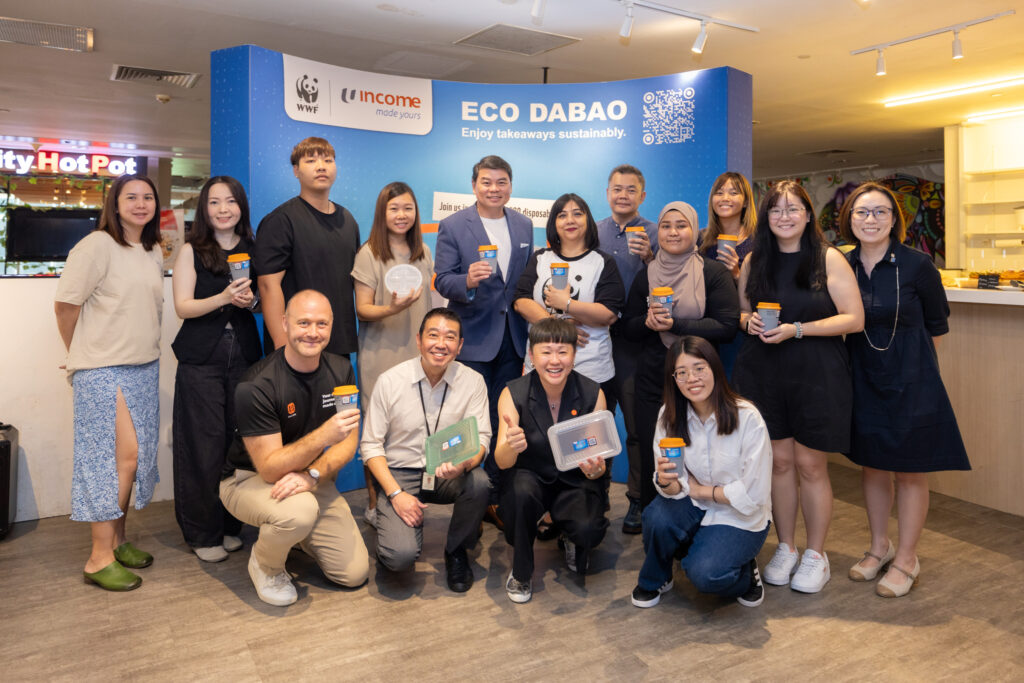
Borrow, Enjoy, Return: Reuse Movement in Singapore
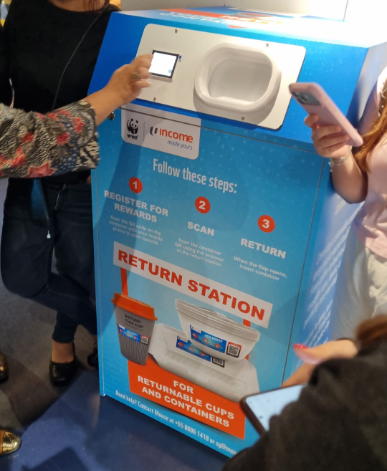
As a collaborative initiative delivered by WWF-Singapore, Income Insurance, and Muuse, with foodpanda serving as the digital platform partner, the system allows users to borrow returnable containers from participating food and beverage (F&B) outlets and return them to any station within the network, regardless of where the food was bought.
Using “Public Smart Return Stations” located across Raffles Place — the heart of Singapore’s Central Business District — the project now partners with nine F&B outlets belonging to eight different brands, with five locations for the Smart Return Stations:
| F&B Outlets | Smart Return Stations locations |
| Cedele – CIMB Plaza Cha Re Re – One Raffles Place Greendot – One Raffles Place Patrons’ Box – One Raffles Place & One Raffles Quay Poke Theory – CIMB Plaza Souperstar – One Raffles Place The Backyard Bakers – Republic Plaza Upshot Specialty Coffee – One Raffles Place | Bank of Singapore Centre – Level 1, Lobby One Raffles Place – Basement 1, next to escalator OCBC Centre – Level 1, Lush Garden Republic Plaza – Basement 1, seating area UOB Plaza 2 – Entrance area near MRT, UOB drop-off point |
User Experience and Operational Flow
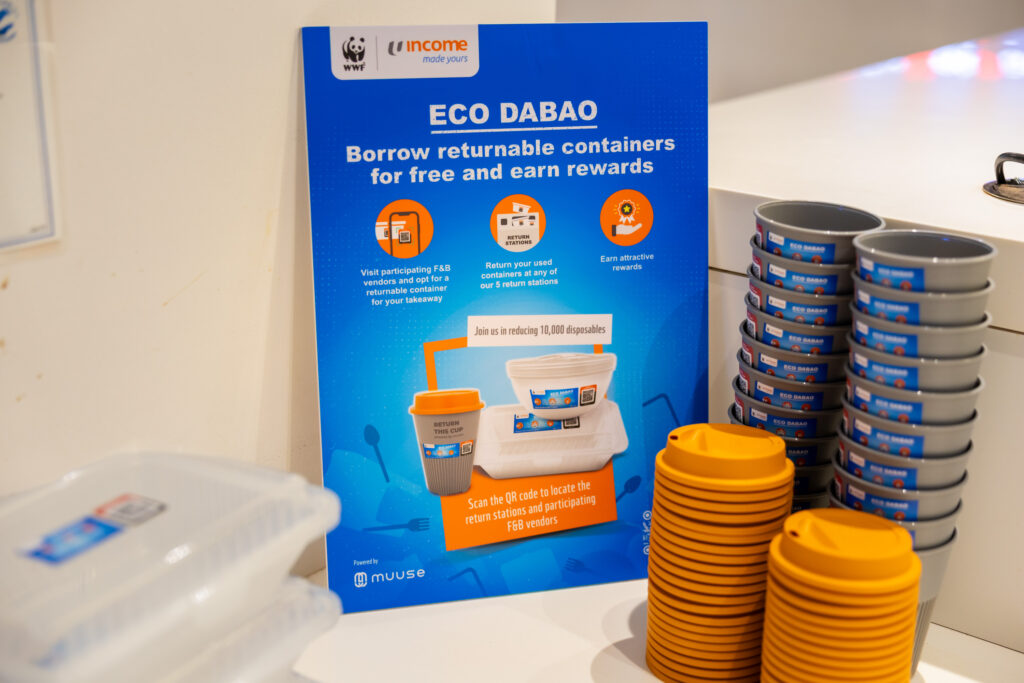
To ensure high adoption rates, Eco Dabao is designed to be accessible and cost-free for both consumers and participating F&B outlets. To encourage consistent use of the system, Eco Dabao includes a rewards mechanism. By creating an account on Muuse mobile app and scanning the QR code on the container at a return station, users can earn points redeemable for e-vouchers at F&B partners such as Kopitiam, KFC, and foodpanda.
The system’s infrastructure, technology, and logistics is managed by Muuse with funding by Income Insurance as the anchor partner. By outsourcing logistics and sanitisation to Muuse, the programme allows vendors to adopt sustainable practices without additional operational burden. Digital integration through foodpanda’s food delivery platform provides additional access to the district’s office workers without added costs, although currently the feature is only available for limited items.
The programme provides two distinct methods for accessing returnable containers, catering to both digital and in-person transactions.
- Digital Integration via foodpanda
For customers using the foodpanda platform, the option to use a returnable container is available exclusively for pick-up orders for select items. Users can opt-in at the menu level when placing their order, ensuring the meal is prepared in reusable packaging before they arrive at the outlet.
- Direct In-Person Orders
Diners ordering directly at a participating F&B outlet for either dine-in or takeaway can request a returnable container at the counter. To initiate the process, the user scans the QR code located on the container with their mobile device. For those who scan using a Muuse account, this step registers the container to the user’s account and allows them to participate in the associated rewards programme.
Hygiene, Inclusivity, and Quality Standards
To ensure public trust, Eco Dabao addresses sanitisation and cultural inclusivity through specialised infrastructure and strict maintenance protocols. The programme utilises Smart Return Stations equipped with QR-activated, sealed flaps. This design ensures that only verified containers are accepted, preventing the disposal of general food waste or unapproved items. Used containers are collected weekly and professionally sanitised at a licensed centralised facility to meet commercial food safety standards. Real-time monitoring of station fill-levels ensures timely collections and maintains site cleanliness.
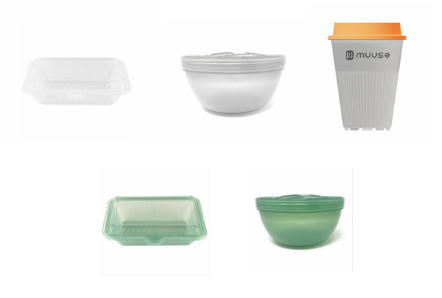
In alignment with Majlis Ugama Islam Singapura (MUIS) – the Islamic Religious Council of Singapore’s Halal guidance, the system employs a strict colour-coded separation protocol. Green containers are reserved for Halal-certified food, while the white containers are used for non-Halal food.
These containers are returned to the stations closed, then transported for processing in dedicated, independent washing streams. This ensures Halal integrity is maintained throughout the entire logistical and sanitisation cycle.
All food containers and beverage cups are manufactured from high-quality, food-grade polypropylene. This material is temperature-resilient for hot and cold items and is safe for use in both microwaves and dishwashers. Each item is designed for up to 1,000 reuses, significantly reducing the environmental footprint compared to single-use alternatives. Frequent quality checks ensure that damaged containers are removed from the cycle and recycled locally in Singapore.
Strengthening Collective Action for a Zero-Waste Future
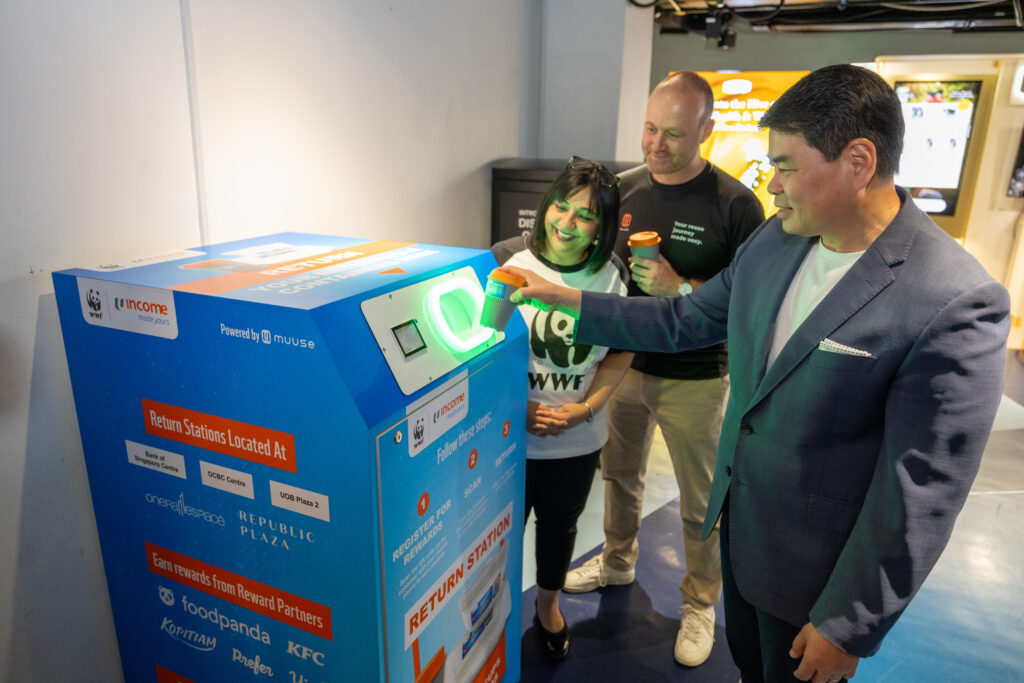
The five-month pilot runs from now until September 2026. During this period, Income Insurance, WWF-Singapore, and Muuse will gather insights on user behaviour, return patterns, and system adoption to refine how the reuse system can be further improved and implemented more effectively at scale in Singapore. The pilot will also continue expanding its ecosystem partners, with participating F&B vendors expected to increase to 15 locations by July.
Eco Dabao supports the National Environment Agency’s (NEA) Say YES to Waste Less campaign and the Ministry of Sustainability and the Environment’s (MSE) Go Green SG initiative, which rallies citizens, organisations, and the community to take collective action towards a more environmentally sustainable and climate-resilient Singapore.
“Much of today’s packaging waste is the result of systems designed for single use. Shifting this requires more than incremental fixes—it calls for rethinking how materials are used, reused, and kept in circulation. As WWF-Singapore marks our 20th anniversary, initiatives like Eco Dabao reflect a deliberate focus on working with partners to test and scale practical solutions that can shift everyday behaviours. In a dense urban context like the CBD, Eco Dabao demonstrates that reuse can be both viable and convenient when the right systems are in place. What enables this shift is collaboration. When businesses, communities, and the public sector align, sustainable choices become easier—and more likely—to be adopted at scale. This is how we move reuse from the margins into the mainstream.” Sophia Zhu, Chief Operating Officer at WWF-Singapore, highlight how partnerships are essential in tackling plastic issue with enabling systemic change.
With the CBD being one of Singapore’s highest densities of F&B outlets, which sees large lunchtime peak loads, the pilot aims to reduce 10,000 single-use packaging items over the five-month period, presenting a strong opportunity to reduce food packaging waste at scale.
Read more on the: https://plastic-action.asia/transforming-fb-packaging/
Also read the case study on Hong Kong Reuse Programme with FoodPanda