Case Study
Indonesia: Bekasi, Bogor, Depok (Greater Jakarta)
WWF Involvement: December 2023 to June 2025
Focus Area: Recovery and Recycling
PSC Approach: Recycling
Systemic Intervention: Systems and Infrastructure
Key Lessons Learned
- Diversifying offtakers helps to stabilise cash flow and improve market resilience: Working with a diversity of offtakers who accept different types of materials (in this case, accepting both shredded and non-shredded plastic) allows for greater flexibility, supports steady revenue, and opens access to higher-value sales. Tailoring product types to match market demands can also help secure longer-term offtake agreements.
- Digital traceability systems strengthen oversight and unlock financing opportunities: Implementing traceability tools enhances transparency, enables impact-driven reporting, and supports access to blended financing mechanisms, including plastic credits – however, see WWF’s Position Paper on Plastic Crediting and Plastic Neutrality (April 2025).
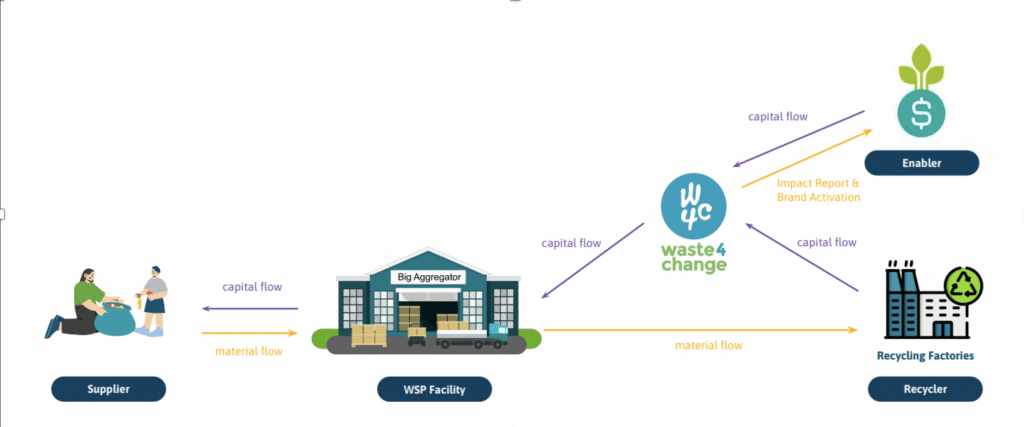
- Connecting waste banks directly to aggregators improves supply chain efficiency: Streamlining material flows by linking waste banks with aggregators and recyclers reduces logistical inefficiencies and increases the overall effectiveness of the recycling system as exemplified by the strategic partnership with RECO.
- Integrating informal waste workers can enhance system performance and speed up onboarding: Formalising the role of informal waste workers helps harness their existing expertise, minimising the need for extensive retraining while improving operational efficiency within structured waste systems.
Background
Since 2014, Waste4Change (W4C) has operated as a social enterprise, in the private sector, focusing on processing flexible plastics (PP) and strengthening partnerships with junkshops through its W4C Supplier Partnership (WSP) model. This initiative aims to expand processing capacity, while empowering junkshops by upgrading their infrastructure, formalising informal waste workers, and enabling them to grow their businesses and improve waste management systems in Bogor, Depok, and Jakarta.
W4C primarily collects waste from businesses (offices, banks, and embassies) over households due to their higher willingness-to-pay and alignment with their corporate social responsibility and environmental, social, and governance (ESG) commitments. Customers are provided with separation bags to encourage wet and dry waste sorting, though separation is inconsistent.
Prior to the collaboration, waste collection processes were primarily manual, with modest capacity and informal data tracking. The partnership with WWF seeks to support improved operational efficiency, expand collection capacity, and contribute to the reduction of plastic leakage.
Objectives
- Collect 2,300 tonnes of plastic waste for recycling by June 2025.
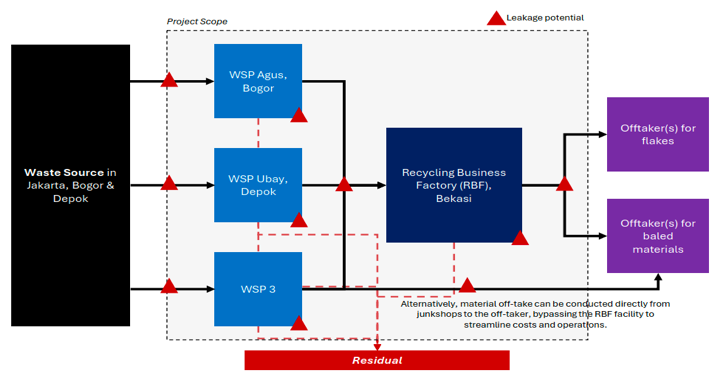
- Establish three collection hubs by upgrading informal waste collectors in Bogor, Depok, and Bekasi.
- Set up pre-treatment facilities to process plastic waste into flakes.
- Implement a digital traceability system to ensure transparency and data-driven operations.
Key Successes
- WSP Infrastructure Development: W4C enhanced the waste processing capacity of eight junkshops by upgrading their facilities with roofs, equipment, personal protective equipment (PPE), and training on waste handling, health and safety, and digital data recording. These upgrades have helped create safer, more efficient workspaces and have enabled WSPs to grow their businesses, optimise operations, and increase processing capacity. This in turn has contributed to ensuring a more consistent material flow to W4C, supporting operational continuity beyond the grant period.
- Revenue generation is progressing, with profitability anticipated as operations mature: In its first year, W4C successfully generated revenue, including 5% from plastic sales. Additional income has been supported through plastic credit mechanisms and strategic partnerships such as with RECO for consistent feedstock. The business model is continuing to evolve toward long-term profitability.
- Digital traceability system: The internally developed digital traceability system enables real-time tracking of waste collection, transportation, and processing. This supports greater transparency and compliance with certification standards. Integrated system applications facilitate waste transactions, while plastic credits enhance traceability by verifying recovered and recycled materials. This has strengthened credibility with corporate partners and supported ESG-related reporting.
Key Challenges
- Low shredding capacity impacts value recovery from materials: At present, most plastic is sold in unshredded form (IDR 1,600–2,200/kg) rather than as higher-value shredded material (IDR 3,900–4,000/kg), due to processing capacity. While this helps avoid stockpiling and ensures material flow, opportunities remain to enhance value through expanded shredding operations.
- Slower material turnover in some cases has resulted in stock build-up and potential financial exposure: Where immediate market demand has not materialised, sales have been delayed, leading to temporary stock accumulation and possible depreciation. Strengthened monitoring and inventory systems are being developed to support more responsive management.
- Adoption of internal systems is progressing at different paces among partner junkshops: Some long-standing junkshops are in the process of transitioning to W4C’s standard operating standards, including traceability systems and worker welfare protocols. A monitoring framework supports this process and facilitates continued capacity building and alignment.
- Flexible plastics continue to present transport and processing challenges: Due to their nature, flexible plastics are more prone to material loss during handling and transport. This is a recognised area for ongoing operational refinement.
Resources
- Support and infrastructure: WWF provided investment to support construction, facility upgrades, salaries, and procurement of key machinery such as blowers, shredders, and pre-treatment facilities for shredding and flake production to increase facility processing capacity to 150 tonnes/month.
- Human Resources: There are 16 employees at the Bekasi facility, including project managers, administrators, waste collectors, facility operators, and data monitoring teams.
- Stakeholder engagement: W4C collaborates with vetted WSPs who have sufficient capacity to sustain operations.
Enabling Factors
- Blended financing: Funding from different sources (private equity, development organisations, and market-based mechanisms including plastic credits) enabled W4C to expand its recycling operations, invest in infrastructure and equipment, and support waste worker livelihoods.
- Eight junkshops upgraded with machinery, PPE, and training on safety, sorting, and data management allow more consistent material supply for processing.
Risks & Opportunities
- Testing blended finance models: Providing successful financial models through blended finance for plastic waste management opens up the possibility for replication.
- Policy around plastic crediting: Governments to look at strengthening regulations to ensure better transparency and clarifying stakeholder roles.
- Achieving long-term financial viability will benefit from continued efforts to strengthen offtaker relationships and enhance operational efficiency. Exploring opportunities to expand beyond low-value plastics may also support improved market resilience and revenue diversification.
© WWF-Indonesia