Case Study
Philippines: Cagayan de Oro
WWF Involvement: May 2023 to November 2024
Focus Area: Enabling Framework
PSC Approach: Monitoring and Assessment
Systemic Intervention: Knowledge Strengthening
© WWF-Philippines
Key Lessons Learned
- Baseline assessments are critical for strategic planning: The use of data collection tools such as the Waste Analysis and Characterisation Study (WACS), Waste Wise Cities Tool (WaCT), Waste Flow Diagram (WFD), and Knowledge, Attitude, and Practice (KAP) surveys provided essential baseline data to inform decision-making. These tools enabled the development of interventions aligned with national waste reduction goals, including improvements in source separation and material recycling.
- Recycling infrastructure is key to achieving waste diversion targets: The absence of local recycling facilities limits the effectiveness of waste segregation at the community level and interrupts the full waste stream cycle. Establishing this infrastructure is essential for supporting diversion from landfill and extending the lifespan of the sanitary landfill.
Background
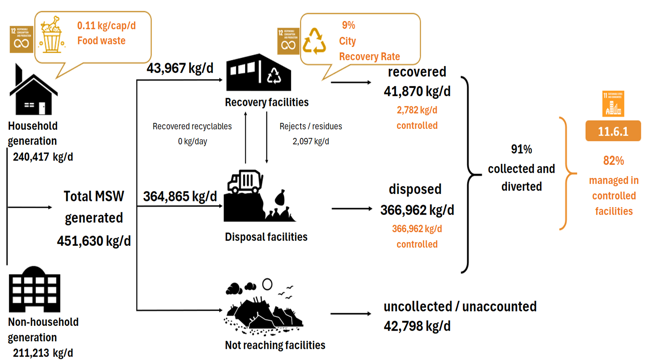
Cagayan de Oro City is a major urban centre in the Philippines. In 2024, the city generated around 450 tonnes of municipal solid waste (MSW) per day, of which 18% was plastics (80 tonnes). Its coastal location, nearby 12 major waterways, and high population of 775,540 make it particularly vulnerable to plastic waste leakage into marine environments, with unmanaged plastic waste (sum of uncollected and leaked plastic waste from the MSW management system) representing 11% of the total plastic waste generated (AMH Philippines Inc., 2024).
Following PSC’s Plastic Smart Guide for Cities, the city conducted a baseline in 2024, including a Waste Analysis and Characterisation Study (WACS), Waste Wise Cities Tool (WaCT), Waste Flow Diagram (WFD), and Knowledge, Attitude and Practice (KAP) surveys. The baseline assessment played a central role in identifying waste generation sources, recycling gaps, and leakage points.
Objectives
- Quantify waste generation and composition at household and non-household levels and assess waste collection, recycling and disposal to provide data to update the city’s ten-year SWM plan (2018 to 2027).
- Identify sources and pathways of plastic waste leakage and recommend improvements in waste management infrastructure.
- Increase community participation in waste separation through behavioural change initiatives and incentives.
Key Successes
- Baseline data directly informed the update of Cagayan de Oro’s ten-year SWM plan.
- High community willingness: 95% of the 67 surveyed households expressed willingness to participate in environmental programmes, increasing to 97% when incentives were provided. Additionally, 55% of households adopted waste separation practices after targeted awareness campaigns, contributing to increased waste recycling rates.
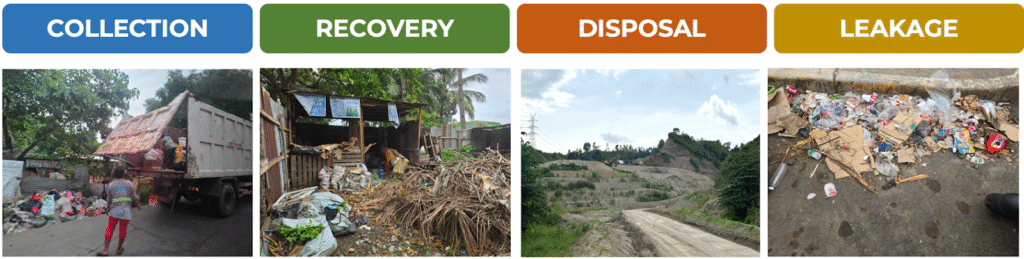
- Waste Diversion: Establishment of barangay MRFs and centralised recycling systems. About 50% of the city’s barangays now have functional centralised MRFs, leading to increased diversion of recyclables from landfills, particularly PET and HDPE plastics.
- Plastic Leakage Reduction: Data-driven decision making allowed for a combination of improved collection routes, recycling programmes, and trash traps, reducing annual plastic leakage by preventing 4.8 tonnes of plastic waste from entering water systems.
Key Challenges
- Instances of waste mixing during transport were observed, as collection vehicles were not compartmentalised. This affected the overall effectiveness of segregation efforts and highlights an opportunity to strengthen alignment between source separation and transport systems.
- Modest reduction in plastic leakage despite efforts: While the introduction of improved collection systems, targeted recycling initiatives, and trash traps has contributed to reducing plastic leakage, the estimated 4.8 tonnes/year diverted from waterways suggests that further scaling and reinforcement of these measures may be needed to achieve more substantial impact.
- Plastic leakage: WFD results indicate that 45% of unmanaged plastic waste originates from uncollected waste, while 35% is lost during collection and transport. Addressing service gaps and improving logistics could help mitigate this issue.
- Policy implementation gaps: Although local policies support waste segregation, enforcement and monitoring remain inconsistent. Enhancing policy implementation and compliance mechanisms could further strengthen outcomes, using initiatives such as “no segregation, no collection”.
Resources
- Support: WWF supported with funding and management of the baseline assessment, multi-stakeholder collaboration, creating a stronger feedback loop between government entities, private recyclers, and communities.
- Baseline tools: The WACS provided quantitative data on waste generation and composition, the WaCT provided data on collection, recycling, and disposal, and the WFD assessed leakage points. The KAP surveys and awareness campaigns encouraged community involvement in waste management activities – all were fundamental for baseline data collection.
- Community Engagement: Public awareness campaigns and surveys to understand community needs and design targeted interventions.
Enabling Factors
- Monitoring of waste flows using WaCT and WFD tools to adapt and improve interventions is simple, quick, and is not resource intensive. Ideally, assessments should be conducted seasonally to assess waste fluctuations, and every five years. The tools’ ability to quantify waste flows and community participation ensured tailored interventions.
Risks & Opportunities
- Waste baselining becomes a priority for local and national governments: Governments establish accurate baseline data on plastic waste generation and management to guide interventions and measure progress.
- Strong enforcement of separation policies and enforcement mechanisms are still required, supported by KAP survey findings on community willingness for successful implementation.