Case Study
Thailand: Songkhla and Surat Thani
WWF Involvement: October 2023 to December 2024
Focus Area: Enabling Framework
PSC Approach: Recycling
Systemic Intervention: Financing and Funding Mechanisms
© RWA Group
Key Lessons Learned
- Leveraging private sector partnerships can accelerate and scale impact: Collaborating with companies involved in material processing and waste collection has shown strong potential to expand project outcomes. The use of existing infrastructure and distribution networks can significantly enhance plastic recycling efforts.
- Tailored economic instruments support context-specific market transformation: Applying a locally adapted pricing strategy that subsidises plastic collection and processing helps reshape Thailand’s plastic market in the short term. This approach supports system viability until plastic material values become more competitive and Extended Producer Responsibility is established. This solution is specifically adapted to Thailand’s plastic market.
- Diversified revenue models can strengthen economic sustainability: Partnerships with businesses that generate income from multiple streams – such as collection services, material sales, and recycling – demonstrate that solid waste management systems can be both environmentally and economically sustainable, increasing their appeal to investors.
Background
In many Thai cities, the costs associated with collecting and processing plastics often exceed the market value of recyclable plastic. In Songkhla, lower market prices are influenced in part by challenges related to material quality, including contamination. This results in a need for additional sorting, cleaning, and preprocessing before materials can meet the standards required by offtakers.
These conditions highlight the importance of ongoing systemic improvements – such as enhanced separation at source – to increase the quality of recyclables and improve overall efficiency. They also point to the potential value of continued financial support for material recovery facilities (MRFs) to enable them to operate sustainably and move towards profitability.
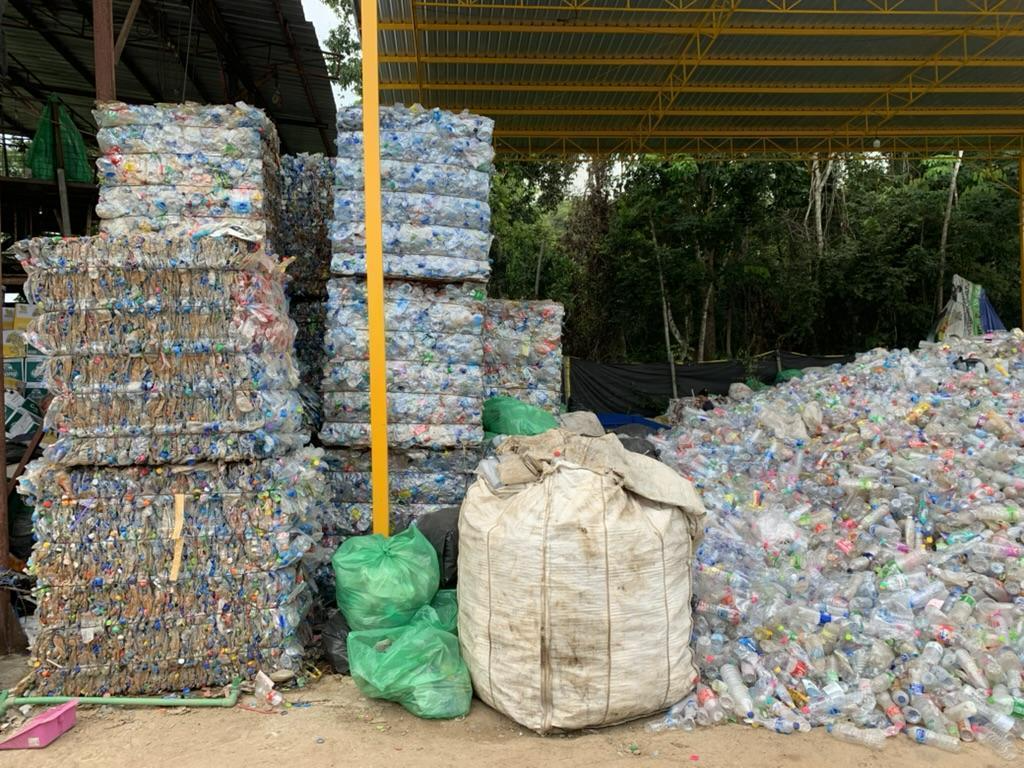
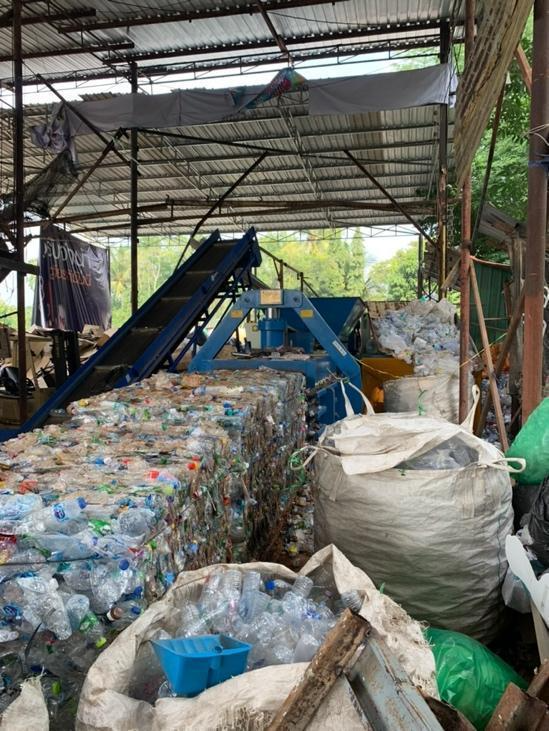
In order to increase the amount of plastics collected and recovered in Surat Thani and Songkhla, two MRFs were established under this project implemented with Thai Ocean Plastics (TOP). TOP collects, sorts and recycles Ocean-Bound Plastics and is currently managing a first MRF facility, located in Surat Thani and operated by ENG Consultant Co., Ltd. Another MRF facility is operated by CGS Supply and Equipment Service Co., Ltd in Songkhla. To boost low-value plastics recovery, MRFs received financial incentives to accept materials from waste banks and pickers, ensuring these plastics are processed rather than discarded.
End-to-end interventions were enabled across the plastic supply chain by collaborating with ENG and CGS to optimise their facilities and enhance their effectiveness in working with small-and-medium-sized suppliers (i.e. junkshops). TOP provided a fixed incentive mechanism directly to the MRFs, in order to increase the volume of materials flowing through their facilities and make a profit from the sales of more materials. Collectors in Surat Thani and Songkhla receive a fixed incentive aligned with WWF’s project budget.
Objectives
- Increase plastic waste collection and recycling by stabilising the market and creating a sustainable price structure, particularly as Extended Producer Responsibility (EPR) support is anticipated in the coming years.
- Stabilise the market through the implementation of an incentive mechanism.
Key Successes
- Between October 2023 to December 2024, over 1200 tonnes of plastics collected, including:
- Over 720 tonnes of plastic recovered by ENG, above their target of 500 tonnes;.
- Over 510 tonnes were collected by CGS above their 500 tonnes target.
- The above included over 10 tonnes and 8 tonnes of non-recyclable low-value plastics, respectively.
- Operational efficiency gains have led to a reduction in the cost per tonne for processing and collection at the MRFs. Costs decreased from USD 482 in 2023 to USD 351 in 2024 and are projected to reach USD 148 in 2025 as processing volumes increase and systems are further optimised.
Key Challenges
- Material quality and source separation practices influence processing efficiency: Mixed waste streams require additional sorting from general plastic waste. For instance, oil bottles must be cleaned, while green tea bottles often have printed screens that, once removed, increase their sale value. These additional steps, while adding value, also require more sorting time and labour. Current separation practices at the city level present ongoing opportunities for improving operational efficiency.
- Collection service coverage affects facility throughput: The volume of materials reaching the TOP facilities is shaped by the extent of current collection services connecting to the MRFs. As a result, facilities are not yet operating at full capacity, suggesting potential benefits from expanding and optimising the collection service.
- Distance and financial feasibility influence partnership opportunities: Oxytech, a flake production facility located in Krabi, was considered for sorting and washing. However, the geographical distance between CGS and Oxytech presents logistical considerations on transportation cost.
Resources
- Support: The incentives provided to TOP were funded by WWF, who also provided operational support to TOP, including funding the rent of two MRFs, and provision of horizontal baling machines, loaders, and incentives. The incentive scheme provides 3.5 THB/kg to support plastic collection and transport. The goal is to stabilise the market by ensuring a predictable price structure, to reduce financial risks for waste collectors while increasing material recycling rates.
- Partners/stakeholders: TOP, local junkshops, end-of-chain recyclers for low-value plastics (e.g. bottle-to-bottle recycling, fiber manufacturing sectors, flake production with Oxytech), premium market offtakers in Bangkok.
Enabling Factors
- Network Effectiveness: The integration with key players for collection, recycling and end-of-chain recyclers can position MRFs to address gaps in the value chain, and scale as a complete supply chain solution.
- Operational strength: An MRF’s strong performance highlights the scalability of existing operations. Expanding the capacity of other local MRFs may help improve regional performance and balance recycling outcomes.
- Market stabilisation: Continued support to improve sorting for low-value plastics and reduce leakage strengthens the MRFs’ resilience against market fluctuations and reduces dependency on incentives.
Risks & Opportunities
- Market stabilisation and dependency on incentives could be mitigated through scaling operations in underperforming areas, enhancing logistics, and leveraging partnerships to optimise the full supply chain from collection to processing and offtake.