Case Study
Viet Nam: Hue
WWF Involvement: September 2022 to December 2024
Focus Area: Enabling Framework
PSC Approach: Local Policy and Regulation
Systemic Intervention: Strategy Development / Policy Advocacy
Key Lessons Learned
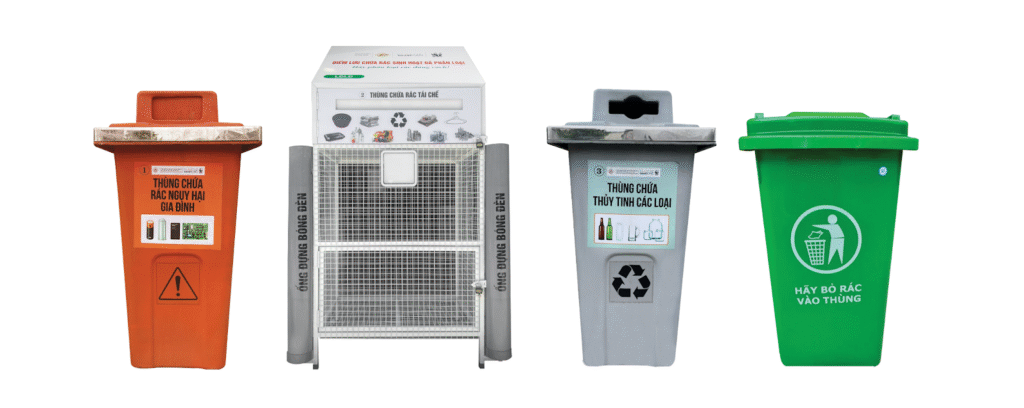
- City adoption and monitoring of a City Action Plan allows for adaptive management, strengthening implementation through real-time learning: strong support from local municipalities and active supervision and responsive adjustments contribute to better results on the ground. For instance, early confusion around bin use led to misplaced waste, prompting the project to recommend design modifications – an example of how small, timely adaptations can improve clarity and reinforce programme goals.
- Coordinated timing of activities maximises impact and avoids inefficiencies: Providing a system of separation bins, waste bags, and green houses worked most effectively when aligned with training sessions for local government officials, residents, and schools. Rolling out activities in a synchronised and logical sequence – such as delivering training and local government enforcement when equipment is distributed – may ensure understanding and avoid duplication of efforts.
- Behaviour change is a long-term process that benefits from continuous support: Encouraging waste separation at source requires ongoing advocacy, consistent engagement from public authorities and civil society, and dedicated resources. While policies and regulations play a role, their effectiveness is significantly enhanced when combined with awareness raising, training, and community capacity building.
Background
The journey towards “Hue – A Plastic Smart City in Central Viet Nam”, started with conducting baseline studies guided by the Plastic Smart Cities’ (PSC) Plastic Smart Guide for Cities, to assess the current state of solid and plastic waste management, identify relevant stakeholders and crucial interventions. Accordingly, community consultations and interviews with national and international experts were conducted to develop a City Action Plan (CAP) for 2022 to 2025.
The CAP sets specific targets to reach the overall goal: reducing plastic waste leakage into the environment by 30%. To achieve such a goal, Hue City’s People’s Committee issued the CAP (Plan No. 1121/KH-UBND) on 22 February 2022, which describes the implementation and management of plastic waste in Hue city by 2025, with a vision to 2030.
The plan states that plastic waste management is a part of integrated solid waste management (ISWM) and is a shared responsibility of society, with the State playing a leading role. Key measures of the CAP include increasing plastic waste collection at fixed points, promoting recycling and safe disposal of solid waste, minimising single-use plastics (SUPs) and raising public awareness of environmental protection. This will be realised through increasing investment, promoting socialisation and maximising all possible resources.
Objectives
- Support Hue city to protect the rivers and ecosystems of wetlands and coastal areas from being polluted by plastic waste.
Key Successes
- Phased Implementation for Measurable Impact: The CAP was rolled out in stages, including strengthening communication, training, plastic waste separation at source and building pilot models such as “Plastic waste free school” and “plastic waste reduction market”.
- Phase 1: Implemented in six wards, reducing plastic leakage by 72 tonnes.
- Phase 2: Expanded to 18 wards, reducing plastic leakage by 392 tonnes.
- Phase 3: Reached 19 wards, achieving a total reduction of 570 tonnes.
- Targeted Infrastructure Deployment:
- 272 dedicated bins were distributed for safe disposal of pesticide packaging, reducing agricultural plastic waste.
- 100 large net bags were provided to fishermen to support the collection of ocean-bound plastics and fishing gear waste.
- 6,000 households and 101 schools participated in participatory action-oriented training (PAOT) on waste separation at source (WSAS), plastic waste reduction in schools and in daily life, encouraging long-term behavioural change.
- Implementation of integrated SWM principles: By promoting the collection, sorting, and recycling of plastic waste, the initiative contributed to the development of local collection services and recycling markets, supporting an integrated development of the SWM system.
Key Challenges
- Coordination timing and implementation delays: Effective coordination among stakeholders, including local authorities, businesses, and civil society groups, required significant effort. Aligning schedules, responsibilities, and resources often led to delays in rolling out initiatives.
- Sustaining public engagement: Encouraging long-term behaviour change in WSAS proved challenging. While initial enthusiasm was high, maintaining participation required continuous advocacy, incentives, and public outreach.
- Limited financial resources and incentives: The transition away from single-use plastics and implementing sustainable waste management practices required financial support. Many businesses and households hesitated due to the additional costs associated with alternatives and waste separation.
Resources
- Support: WWF funded city-wide waste separation facilities and equipment, including public trash bins, bins for the households, and two compactor trucks.
- Human resources: WWF staff provided training for officers in 36 wards/communes and neighbourhood groups, as well as intensive technical support and funding for 18 pilot wards/communes.
- Partners/stakeholders: The project supported key local organisations, including the Women’s Union, Veterans’ Association, Farmers’ Association, Fishery Association, and Thuan An Fishing Port, in conducting outreach and awareness campaigns on WSAS. The Hue City People’s Committee was the beneficiary and executive agency.
Enabling Factors
- This initiative had active participation from the entire community, involving local authorities and stakeholders in coordinating the collection, transportation, and waste recycling stages.
- The baseline assessment (which included the application of the Waste Wise Cities Tool and Waste Flow Diagram methodologies) helped with driving evidence-based decision-making and targeting key interventions with a higher chance of impact.
- The CAP had clear targets to ensure alignment with national/municipal SWM strategies.
- Substantial funding assisted the city in procuring collection equipment and organising communication campaigns to ensure lasting change.
Risks & Opportunities
- Shifting political priorities and varying levels of policy support: Changes in political leadership may influence the continuity of support for the CAP, as priorities evolve. In some cases, enforcement mechanisms may not yet be fully established, which can affect adherence to waste reduction policies. Continued engagement with local authorities on this topic will support further sustainability of operations.
- Baseline assessments: If they are inadequately detailed or become outdated due to prolonged intervals between data collection and implementation, there is a risk that interventions may no longer align with current needs, particularly in rapidly evolving solid waste management environments. Building in regular assessments on the city’s waste flow into future plans will ensure adaptive management where needed.
- Coordination among stakeholders remains a complex task: City authorities, private sector actors, NGOs, and communities may hold differing priorities or expectations, which can pose challenges for unified planning and implementation. Further organisation of multi-stakeholder consultations may support coordination & alignment.
- Funding constraints and financial sustainability considerations: Constraints in budget allocation for waste infrastructure, incentives, and awareness campaigns may affect the timely implementation of the CAP. In addition, continued reliance on donor funding without a clear long-term financing strategy may present risks to programme continuity, thus requiring diversification of funds potentially through EPR or city allocation.