WWF | Reuse on Christmas Market: Guidelines for Municipality
As traditional Christmas markets across Europe strive to align with modern sustainability goals, the transition from single-use plastics to circular systems has become a priority for local governments. To support this shift, WWF Germany and the “mehrweg. einfach. machen.” alliance have released a comprehensive set of guidelines designed to help municipalities implement scalable reuse systems. […]
WWF Vision Statement: Responsible Use of Alternative Materials to Address Plastic Pollution
Plastic pollution is an urgent environmental crisis that demands a significant reduction in plastic production and a shift away from fossil-based feedstocks. While many look to materials like paper, metal, or glass as a primary solution, substitution must be applied thoughtfully as part of a broader suite of interventions. To ensure positive outcomes for both […]
PROBLUE, World Bank Group | Behavior Change in Solid Waste Management: A Compendium of Cases
While infrastructure and technology are essential, the success of any waste system ultimately depends on human action. The World Bank’s Behaviour Change in Solid Waste Management: A Compendium of Cases explores the psychological and social drivers that determine how waste is managed at the household level. For practitioners and city leaders—particularly in rapidly urbanising regions […]
World Bank Group | What a Waste 2.0: A Global Snapshot of Solid Waste Management to 2050
In an era of rapid urbanisation, data is the most powerful tool for cities aiming to become plastic-smart. What a Waste 2.0: A Global Snapshot of Solid Waste Management to 2050 provides the essential metrics required to navigate this transition. Covering waste generation trends across 217 countries and territories, this World Bank report serves as […]
World Bank Group | What a Waste : A Global Review of Solid Waste Management
Before a city can implement a circular economy, it must first understand the scale of its waste. This foundational World Bank review, What a Waste: A Global Review of Solid Waste Management, provides the essential baseline for global waste data. As urbanisation and wealth increase across rapidly growing regions like the Philippines, India, and Indonesia, […]
World Bank Group | What a Waste 3.0: Global Snapshot of Solid Waste Management Toward Circularity until 2050
As the global plastic crisis intensifies, understanding the trajectory of waste generation is essential for building resilient, plastic-smart urban centres. The World Bank’s latest publication, What a Waste 3.0: Global Snapshot of Solid Waste Management Toward Circularity until 2050, provides a critical data-driven roadmap. This report offers a comprehensive look at current waste management practices […]
ERIA, IGES, Rare | Breaking the Plastic Habit in ASEAN: Behaviour-Centred Interventions for Lasting Plastic Reduction
The plastic pollution crisis in Southeast Asia is reaching a critical tipping point, with plastic waste projected to nearly quadruple in some countries by 2050. While traditional policies and single-use plastic bans are an important start, the report Breaking the Plastic Habit in ASEAN reveals that behavioural insights are the essential missing piece to bridge […]
WWF Policy Brief | Rethinking Participation and Effectiveness: Collective market power as the driving force for an effective treaty to end plastic pollution

Negotiations on an international legally binding instrument to end plastic pollution have reached an impasse. While a clear majority of countries now support binding measures across the full life cycle of plastics, progress has been repeatedly stalled by a small group of states opposing such measures. Resolving this will require negotiators to lift their gaze […]
C40 | Toolkit for cities: Practical actions to integrate informal waste workers into municipal solid waste management systems
As cities worldwide strive to meet ambitious zero-waste targets, the contribution of informal waste workers (IWWs) has become a cornerstone of sustainable urban management. This toolkit provides municipal authorities with a practical, step-by-step roadmap to recognise, protect, and integrate these essential workers into formal solid waste management systems. By prioritising social dialogue and inclusive policy-making, […]
UNDP, Viet Nam NPAP | Research on the integration of independent waste workers in solid waste management in Viet Nam
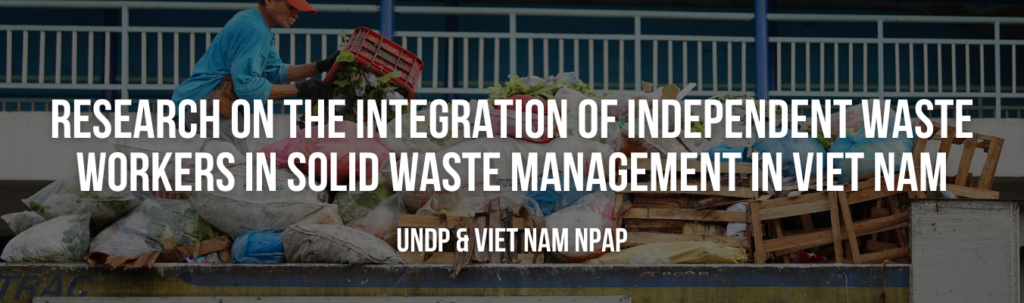
How can Vietnam achieve its ambitious target of increasing plastic recycling from 11% to 38% by 2030? The answer lies in the strategic integration of Independent Waste Workers (IDWWs). This 2025 study by UNDP Viet Nam provides a comprehensive roadmap for transitioning the informal waste sector into a formalised, rights-based system. By addressing institutional barriers […]