Case Study
Indonesia: Bogor, Depok, Jakarta
WWF Involvement: June 2022 to October 2024
Focus Areas: Reduction
PSC Approach: Behavioural Change
Systemic Intervention: Knowledge Strengthening
© WWF-Indonesia
Key Lessons Learned
- Creating plastic-free canteens supports measurable waste reduction: The move to reusable containers and requiring vendors to manage their own waste led to a notable reduction in plastic waste, showing the value of involving all food service actors.
- Zero-Waste Schools simplifies waste management systems: Focusing waste streams on organic, paper, and cardboard made school operations more manageable and reduced the need for additional separation at source bins.
- Empowering student leaders nurtures ownership and participation: Assigning “waste captains” promotes peer involvement and personal responsibility, contributing to the initiative’s success.
- Embedding education and engagement allows for long-term impact: Ongoing environmental education for students, teachers, and parents helped create a shared commitment to zero-waste goals.
- Reinforcing take-home policies can help reduce plastic on-site: Encouraging students to bring plastic waste home helped minimise waste accumulation at school, although it highlights the importance of continued guidance to ensure proper disposal at home.
Background
In 2022, the PSC Zero Waste School initiative was launched by WWF-Indonesia in three pilot public schools located within the Ciliwung River Basin, which runs through Jakarta, Bogor, and Depok. The programme focuses on elementary and junior high schools to instill sustainable habits from a young age.
One of these schools is in Jakarta, and is officially designated as a Net Zero Carbon School, awarded by the Green Building Council Indonesia, as part of the city’s goal to achieve Net Zero Emissions by 2050. This school requires students to take plastic waste home, preventing waste accumulating in school. In principle, no waste is generated in the school – organic waste from the grounds is composted on-site, a plastic-free canteen is employed where students bring reusable lunch boxes and cutlery to minimise waste. The school aims for zero plastic waste and has implemented a “No Plastic” campaign reinforcing these habits.
The school earned a Greenship award (2022) for Net Zero Health for energy efficiency (saving 30,000 watts/day of electricity using solar panels), carbon balance, and health and comfort. Their recently installed hydroponics system provides hands-on agricultural education, while the fish habitats around the school help control mosquito population. This model has inspired other schools to replicate the model, demonstrating its impact and scalability.
Objectives
- Implement a comprehensive net-zero waste programme, including waste separation, composting, and energy efficiency measures.
Key Successes
- Plastic-free canteen: The school eliminated single-use plastic by enforcing reusable lunch boxes and cutlery, reducing waste. Any leftover food was given back to the external food vendors to dispose offsite.
- There is minimal waste generation, so only two source separation bins are necessary (organic and paper). Organic, paper and cardboard waste are composted, recycled or used in upcycling projects – where students transform paper and cardboard waste into culturally significant artwork, preserving and celebrating their heritage.
- Student empowerment: A rotating “captain of the day” system encourages students to oversee waste management, instilling responsibility.
- Integration of zero waste and environmental education into the school curriculum, ensuring long-term impact.
Key Challenges
- Continued education and reminders are required amongst students to sustain consistency and proper disposal practices.
- Controlling plastic packaging from external food vendors. Although plastic use is banned inside the school, students purchase food wrapped in plastic from outside sources.
- Take-home plastic waste policies reduce accumulation at school but present risks if not paired with adequate disposal education. There is a chance that, without proper supervision, plastic waste may be discarded improperly once offsite.
- Visitor compliance with zero-waste rules requires active monitoring, as frequent visits from external guests and stakeholders introduce an added layer of complexity in maintaining a fully zero-waste environment, requiring continued oversight.
Resources
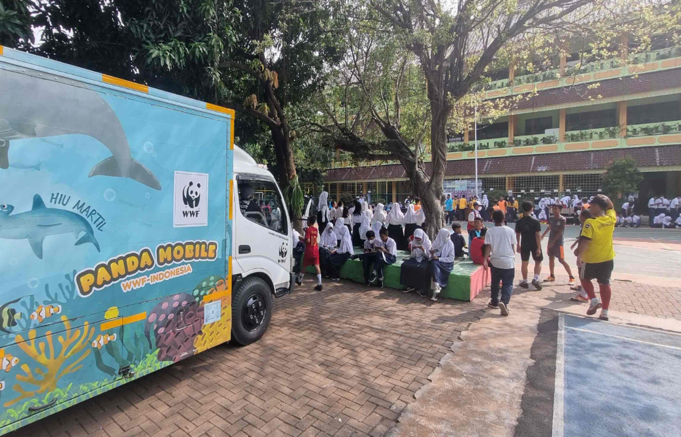
Support: WWF’s role was to connect the school with the Ministry of Education, providing technical support, best practices, and teacher training on waste management and environmental education. Additionally, WWF’s Panda Mobile, a mobile education unit, visited the schools, engaging students through interactive storytelling, games, and craft workshops, making waste management and sustainability education both fun and impactful. The Jakarta Provincial Government provided an estimated 1.6 billion Indonesian Rupiah (around USD 110,000) for operational expenses and maintenance for SDN Ragunan 08 school, including the provision of solar panels.
Infrastructure: The school relies on contracted food vendors who are responsible for taking their waste back with them. Furthermore, an onsite composting area processes organic waste, including shredded leaves and plant debris, using a one tonne/day leaf shredder.
Enabling Factors
Government funding played a key role in enabling early implementation: Support provided to pilot schools allowed for successful demonstration of the model. However, schools with fewer resources may benefit from additional external funding or policy-level support to adopt similar approaches.
Risks & Opportunities
- Teacher and student engagement: Long-term success depends on consistent training and engagement, requiring ongoing curriculum integration.
- Knowledge exchange for scaling: experience sharing with other schools and advocacy to implement or mandate the “Zero Waste School” program nationally.