Case Study
Viet Nam: Con Dao
WWF Involvement: March 2021 to May 2024
Focus Area: Reduction
PSC Approach: Behavioural Change
Systemic Intervention: Policy Advocacy, Knowledge Strengthening
Key Lessons Learned
- Cross-sectoral collaboration enhances scalability and policy uptake for educational activities and plastic waste reduction: Strong partnerships between government agencies, schools, and a private sector recycler enabled the “Plastic-Free School” model to be adopted across all six schools on the island, supporting long-term sustainability and institutional integration.
- Addressing local infrastructure gaps requires external support and coordination: The absence of local recycling facilities, as is usual on small islands, highlighted the importance of working with mainland partners, such as Circular Action Viet Nam, to establish waste management solutions in geographically isolated areas.
Background
Con Dao, like many islands and coastal areas that are relatively small and remote, face unique challenges with waste management. This is due to limited recycling infrastructure and its geographic location that make it susceptible to plastic pollution from marine and land-based activities. Recognising the need for long-term solutions, The People’s Committee integrated plastic waste awareness and reduction into teaching materials and teacher training, across all six schools on the island from kindergarten (3) to primary (1), secondary (1), and high school (1).
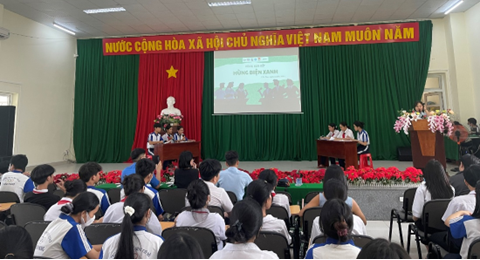
In response, the Department of Natural Resources and Environment, and the Department of Education and Training launched a large-scale teacher training initiative, equipping 180 teachers from six schools with the knowledge to implement the Plastic-Free Schools model.
The programme introduced waste reduction and recycling initiatives in schools, focusing on reducing SUPs, promoting waste sorting, and establishing systems for recyclable materials such as milk cartons. These cartons are multi-layered plastic materials, making them more challenging to recycle and requiring specialised processing solutions.
Objectives
- Embed plastic waste education into school programmes.
- Implement the Plastic-Free School model across Con Dao.
- Reduce single-use plastics through awareness, regulations, and infrastructure.
- Establish a recycling system for key waste streams such as milk cartons and food packaging waste.
Key Successes
Expansion of the Plastic-Free School Model
- In 2021, three kindergartens piloted WWF-Viet Nam’s plastic waste free school model which involved replacing single-use plastics with reusable bags and cutlery, establishing a waste collection and recycling programme for old toys, and raising awareness amongst students, teachers, and parents on sorting and reuse, as well as holding Plastic Recycling Festivals.
- The one primary school then introduced the Plastic Reduction Model between 2022 to 2023, which included SUP reduction, sorting and recycling activities. They also established regulations and action plans for sorting and the reduction of SUPs in collaboration with the secondary and high schools, and launched a milk carton recycling programme with a recycling company, Circular Action Viet Nam. The programme collected 141,280 milk cartons (one tonne) in one year.
- The secondary school led oratory competitions on plastic waste, school-wide plastic bans, and waste sorting competitions, cutting plastic waste by 71%, nearly eliminating disposable plastic cutlery. Sustaining and improving this progress requires ongoing behavioural enforcement to ensure lasting change.
- The high school reformed their canteen and created student-led waste monitoring teams to improve compliance with waste reduction policies.
Key Challenges
- Local recycling infrastructure constraints: In the absence of on-island recycling facilities, schools rely on mainland organisations such as Circular Action Viet Nam to manage collected recyclables. This approach has required additional resources, coordination, and logistical efforts from school staff alongside their existing responsibilities.
- Maintaining long-term behaviour change: While early engagement from students and teachers was encouraging, sustaining commitment to waste reduction and sorting practices over time requires continued reinforcement through education, monitoring, and targeted incentives.
Resources
Support: WWF connected the school to local government, having a supporting and capacity-building role by introducing the plastic free model, developing training materials, and co-creating and implementing the schools’ action plans.
Human Resources: 180 teachers trained by the Department of Education and Training facilitated student engagement and programme implementation.
Stakeholders: Department of Education and Training, Department of Natural Resources and Environment, Con Dao Youth Union (a partner in the project who organised the milk carton collection), Circular Action Viet Nam (recycling partner).
Infrastructure: Schools developed structured waste management action plans, introduced different coloured separation bins, increasing sorting efficiency, and issued the regulation of SUPs reduction in schools, especially in canteens, and displayed posters communicating the message “No single-use plastic in the school” to prompt and support behavioural change and reduce plastic consumption.
Enabling Factors
- Policy support: Government commitment to integrating environmental education into school curricula and the endorsement of the Plastic-Free School model provided a strong foundation for project implementation across all six schools on Con Dao Island.
- School engagement: Teachers played a key role in shaping student behaviour, while community involvement through competitions, awareness campaigns, and incentive-based activities further supported behavioural change.
- Public-private collaboration: Partnerships with recycling and waste management organisations helped ensure that collected waste was appropriately handled and processed.
Risks & Opportunities
- Reliance on external partners: The initiative relies on collaboration with one mainland recycling partner. Disruption to this relationship could affect the continuity of recycling activities and pose challenges for long-term sustainability. Diversifying partners would support continuity.
- Variability in community engagement: The effectiveness of the waste separation and recycling efforts may depend on active and sustained involvement from students, teachers, and parents.
- Knowledge exchange for scaling: experience sharing with other schools and advocacy to further scale Plastic-Free Schools nationally or in islands of similar contexts.