WWF-Philippines kicked off the Circular Operations for a Plastic Pollution-Free Environment (COPE) Project back in the end of 2024, by assessing five of the highly urbanised barangays. Those barangays are: Bagong Silangan in Quezon City, 176-A to F Bagong Silang in Caloocan City, Municipalities of General Luna and Del Carmen in Siargao Islands, and selected barangays of Cagayan de Oro City. The project aims to pilot and develop replicable, sustainable, and circular solid waste management systems. With better collection, segregation, and recycling systems in the targeted areas, it is designed to stop plastic leakage into nature. It involves collaboration from various stakeholders such as Local Government Units (LGUs), waste workers, and communities to build circular economy solutions.
After roughly a year of implementation, here are some of the key milestones that have been accomplished with the stakeholders and communities.
Strengthening Infrastructure for Circular Waste Operations
The Circular Operations for a Plastic Pollution-Free Environment (COPE) Project supported the establishment and strengthening of solid waste management infrastructure and systems to enable functional, community-level circular waste operations across multiple urban and coastal sites. Interventions focused on improving collection efficiency, expanding access to material recovery facilities, and laying the foundation for traceable and accountable waste recovery systems.
A total of 18 new or improved Material Recovery Facilities (MRFs) were established and operationalised across project sites. These included 9 MRFs in Cagayan de Oro, 2 in Del Carmen, 3 in General Luna, 3 in Caloocan City, and 1 in Quezon City. The MRFs serve as critical nodes for waste segregation, temporary storage, and recovery, supporting barangay-level compliance with ecological solid waste management policies and circular waste flows.
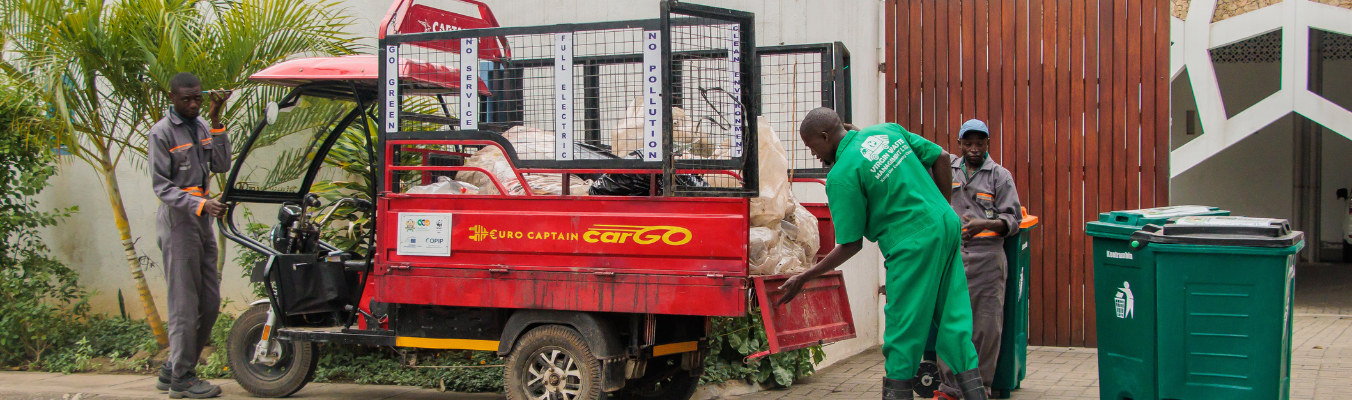
To strengthen collection systems and improve access to waste services, the project distributed key infrastructure and equipment tailored to local contexts. Collection vehicles and transport assets were provided, including motocabs and a dump truck in Cagayan de Oro, motocabs in Del Carmen, a motocab and pump boat for island barangays in General Luna, and multiple motocabs in Caloocan City and Quezon City. These assets addressed logistical gaps, particularly in hard-to-reach and densely populated areas, improving waste collection coverage and operational efficiency.
Complementary equipment, such as pushcarts, was distributed to support door-to-door collection and segregation at source. A total of 15 pushcarts were provided in Cagayan de Oro, 12 pushcarts in selected barangays of Caloocan City, and 25 pushcarts for selected waste workers in Quezon City, directly supporting frontline waste workers and strengthening primary collection systems.
Beyond physical infrastructure, the project also supported the rollout of Material Recovery Systems (MRS) to operationalize circular waste tracking and handling. These included 18 Circular MRS units in Cagayan de Oro, 10 MRS units in Del Carmen, and 15 MRS units in General Luna, enabling more systematic sorting, aggregation, and monitoring of recovered materials. These systems contribute to improved data generation and provide a foundation for future auditable waste recovery tracking mechanisms.


Turnover of Infrastructure Support for Project COPE Sites | ©WWF-Philippines
Optimizing Local SWM Systems through Practical Mentorship and Training: Graduation and Tribute of the GREEN Learners
Other than improving on the ground infrastructure, the project also engaged with three informal waste groups across project sites in improved Solid Waste Management (SWM) activities, livelihood-related initiatives, and participation in the local waste management system. These engagements supported waste worker integration into collection, segregation, and recovery activities, while also fostering recognition of their role in circular waste management.
A total of 16 capacity-building and mentorship activities were developed and implemented across sites, including three activities each in Cagayan de Oro, Del Carmen, and General Luna, and five activities in Caloocan City. These activities covered a range of topics such as proper waste segregation and handling, occupational health and safety, basic enterprise and livelihood skills, and orientation on local SWM policies and roles within the waste management system.
Through these efforts, 448 waste workers were capacitated across project sites. This included 115 waste workers in Cagayan de Oro, 105 in Del Carmen, 130 in General Luna, and 98 in Caloocan City. Capacity-building activities were designed to be practical and context-specific, combining classroom-style learning with hands-on mentoring and on-site demonstrations to reinforce knowledge of application.


Capacity Building Activities and Graduation for GREEN Learners | ©WWF-Philippines
Designing Local Communication Tools for Public Education
Behavioral Change Design Thinking Workshops were held last May to August 2025 for each project site to help equip local SWM officers with the necessary skills and strategies to enhance and improve their communications outputs, focusing on human centered design. These outputs are to be used in each project site to help promote and educate the public on proper waste segregation and to be better informed on the sites’ SWM committee updates. Four prototypes were selected from these design thinking workshops for feedbacking and from there the final finalised communication outputs were created as follows:
- Stickers with waste segregation information
- Posters encouraging proper waste segregation
- Monitoring board for SWM committees to update and inform public
- Junkshop pricelists for easier presentation and information for public


Stakeholders of the project sites providing feedback on the prototypes | ©WWF-Philippines