During the COP30 Local Leaders Forum, in Rio de Janeiro from November 3–5, 2025, WWF and the Alliances for Climate Action mobilised a cohort of 25 fellows from subnational governments in Argentina, Chile, Colombia, Mexico, and South Africa to take part in a series of learning sessions to foster peer networking and forward thinking.

Over the course of four thematic sessions and broader participation in C40 programming, participants explored how cities and regions are driving high-integrity climate action, tackling plastic pollution through community engagement, placing nature at the heart of local climate agendas, and advancing multi-level climate governance through subnational leadership. These dialogues showcased innovative approaches, highlighted practical solutions, and reaffirmed the critical role of local governments in accelerating climate and nature action across Latin America and beyond.
These dialogues sparked new ideas, showcased real solutions, and reaffirmed a powerful movement: local governments are at the forefront of turning climate ambition and nature agendas into action.
Addressing plastic pollution in Latin America: Local action with global impact

Within the framework of Local Leaders Forum at the COP30 in Rio de Janeiro, five Latin American cities, including Ixtlahuacán de los Membrillos (Mexico), Renca (Chile), Cayma (Peru), La Paz (Mexico), and Puerto Barrios (Guatemala), shared their transformative experiences as part of WWF’s Plastic Smart Cities initiative. These cities are demonstrating that local action is key to tackling the plastic pollution crisis.
The session, moderated by WWF-Peru and WWF-Chile, brought together local leaders who are driving innovative plastic waste solutions in their municipalities across Latin America. Speakers from each country shared practical initiatives—from implementing plastic-free policies and developing comprehensive municipal waste management plans, to strengthening on-ground impact with environmental education and community-based waste management – while advancing cross-border coordination. Participants also highlighted progress in waste valorisation through Guadalajara’s Metropolitan Green Points (waste collection and separation centres located at strategic points in the metropolitan area) and in monitoring plastic pollution in the Mapocho River in Renca through collaborative watershed governance.
Strategic Planning for Local Climate Action and Active Community Participation and Leadership
WWF’s Plastic Smart Cities initiative not only drives immediate action but also strengthens municipalities’ technical capacities for long-term planning. Through the development of baseline data on waste generation and characterisation, participating cities have been able to design targeted action plans to reduce plastic pollution. Furthermore, waste collection infrastructure has been created or strengthened, and behavioural change efforts have been implemented, such as through educational campaigns, incentives, and partnerships with local businesses, which motivate more people to reduce, separate, and recycle their waste.
The implementation of Plastic Smart Cities in the region builds on complementary efforts that cities are already undertaking to fight plastic pollution. With the additional support provided through PSC, cities will be able to take the following interventions further.
- In Puerto Barrios, Guatemala, citizens actively participate in Recíclalos, a digital platform that connects citizens with points and alternatives for the disposal and recycling of different types of waste.
- In La Paz, Mexico, the community and the municipal government work side by side: from massive beach cleanups to programmes like Ambassadors for the Earth, where girls and boys lead actions to turn their schools into zero-waste spaces, and the installation of collection points for recyclable waste.
- In Cayma, Peru, more than 470 students have become environmental promoters, promoting eco-bartering, eco-fairs and environmental education campaigns.
Municipalities as Engines of Change
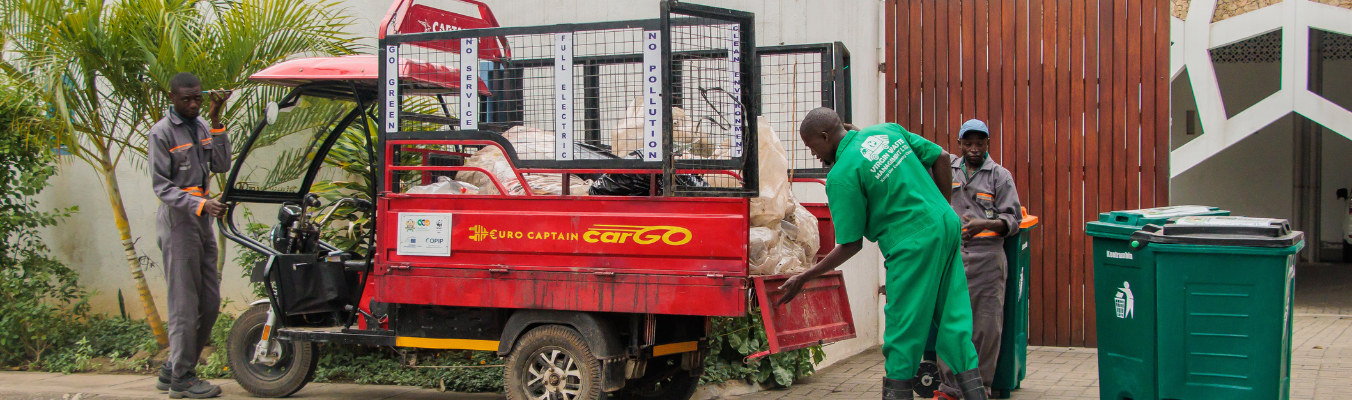
In most countries in Latin America solid waste management is a municipal responsibility. This presents an incredible opportunity to act at the grassroots level and foster citizen engagement. This has allowed local governments like that of Puerto Barrios to develop their own Municipal Integrated Waste Management Plan, independent of national policies. In the municipality of Renca, Chile, a public-private innovation center called La Fábrica leads the way, coordinating efforts with the community to monitor and reduce plastic waste in the Mapocho River. Meanwhile, in the Guadalajara Metropolitan Area, Mexico, nine municipalities have coordinated to install community-oriented Green Points (Puntos Verdes Metropolitanos – PVM), collecting more than 290 tons of waste in less than a year, with 20% comprising recyclable plastic. Overall, the municipality of Ixtlahuacán de los Membrillos is leading the efforts to mobilize the community.
Achievements from Metropolitan Green Points
The Metropolitan Green Points are waste collection and separation centers located at strategic points in the metropolitan area, aiming to support sustainable, circular management of solid waste with a community perspective. The Green Points operate at the neighbourhood level, serving nearby citizens within a walkable area, and accept clean, dry, and pre-sorted recyclable waste, including paper, metal, glass, and plastics such as PET and HDPE/LDPE. Residents are expected to register using their household ID when bringing materials to the Green Points.
The daily operation of the Green Points is the responsibility of each Municipal government that makes up the metropolitan region, with the Municipal Planning Institute supporting the monitoring, evaluation, and operative coherence. The management and disposal of waste is carried out through a private collection service with the corresponding authorizations from the Secretariat of Environment and Territorial Development of Jalisco.
Currently, 10 Green Points are operating, one in each municipality of the Guadalajara Metropolitan Area, in addition to a new module in the CEMEX Community Center, which marks the beginning of the scaling towards private initiative.
Since the opening of the first Green Point in July 2024, the network has achieved:
- More than 2,000 households registered .
- 30 tonnes of waste recovered, equivalent to the weight of a gray whale.
- 70 tons of CO₂ emissions avoided thanks to the improved handling of recyclables.
The Green Point in Ixtlahuacán de los Membrillos stands out as the one with the highest collection, with more than 10 tonnes of waste collected, including 900 kg of plastics.
The Green Point model is part of the Metro Resilience Guadalajara project, an example of multi-level cooperation involving municipalities, the state government, Imeplan (Metropolitan Planning Institute), and international partners such as the European Union and the Barcelona Metropolitan Area.
With support from the Plastic Smart Cities programme, Mexico’s Green Points is now able to continue its infrastructure operations, data collection to provide evidence-based recommendations to the relevant parties (operators, citizens, municipalities, IMEPLAN) to further increase plastic collection, recovery and revalorisation, as well as avoiding plastic leakage into nature.