As global waste generation approaches critical thresholds, illegal waste trafficking has emerged as a major barrier to sustainable development across Southeast Asia. Between 2017 and 2021, ASEAN nations collectively imported more than 100 million tonnes of metal, paper, and plastic waste valued at nearly $50 billion, accounting for 17% of the global plastic waste trade and 20% of the wastepaper trade.
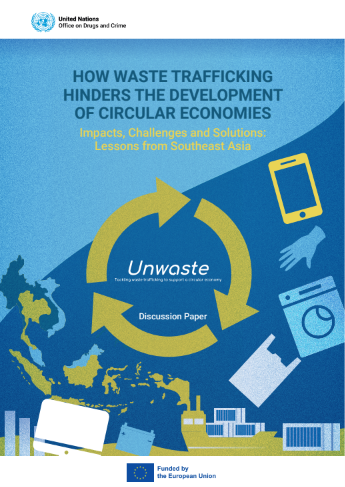
Developed by the United Nations Office on Drugs and Crime (UNODC) and the United Nations Environment Programme (UNEP) with European Union funding, this discussion paper investigates how illicit waste flows compromise circular economy transitions across Southeast Asia. Driven by high disposal costs in high-income regions, organised criminal networks and non-compliant waste management actors exploit regulatory loopholes and corruption to ship hazardous, contaminated, or mislabelled waste into ASEAN member states.
This influx severely damages core circular economy processes most notably “Reduce by Design”, “Reuse”, “Repair”, “Remanufacture”, “Repurpose”, and “Recycle” by introducing toxic contaminants, depressing demand for locally collected waste, and eroding public trust in secondary markets.