Case Study
Thailand: Songkhla City
WWF Involvement: March 2021 to December 2024
Focus Area: Collection
PSC Approach: Community-based Waste Management
Systemic Intervention: Systems and Infrastructure
Key Lessons Learned
- Community ownership models can strengthen commitment and scale impact: The shareholder model, combined with regular surplus allocations, contributed to greater financial commitment and local engagement, supporting the expansion of waste banks, advancing marine conservation efforts, and reinforcing environmental stewardship.
- Reliable market linkages support long-term financial sustainability: Partnerships with Siam Natural Group and Wongpanit Krabi – operators of the local junk shops and MRF – created consistent offtake pathways for recyclables, helping ensure the economic viability of the initiative over time.
Background
Baan Talae Nok and Baan Pang Sai are coastal fishing villages in Songkhla Province, Thailand, where plastic waste mismanagement has contributed to marine pollution and environmental degradation. Until recently, formal waste management systems had not been introduced in these communities, resulting in the gradual accumulation of waste in coastal areas over time.
WWF in collaboration with Thai Sea Watch Association (TSWA) and Wongpanit, established community waste banks to incentivise waste collection and sorting. These banks provide financial returns to members, helping sustain the initiative while reducing plastic pollution.
Objectives
- Establish sustainable waste management systems in coastal fishing communities by implementing community run waste banks.
- Promote community ownership through a shareholder investment model to ensure financial sustainability.
- Strengthen marine conservation efforts by dedicating a portion of waste bank profits to environmental initiatives.
Key Successes
- A community managed shareholder model, inspired by Baan Mod Ta Noi’s community waste bank in Trang City, assists with regular income distribution and financial transparency where members invest 20 THB/share and 10 THB/share, in Talae Nok and Baan Pang Sai respectively (capped at 10 shares/person). Surplus funds are distributed biannually, with 50% to members, 10% for project management, 10% as reserve funds, 15% for member welfare, and 15% supporting marine conservation (SD39 Group and PXP Sustainability, 2025).
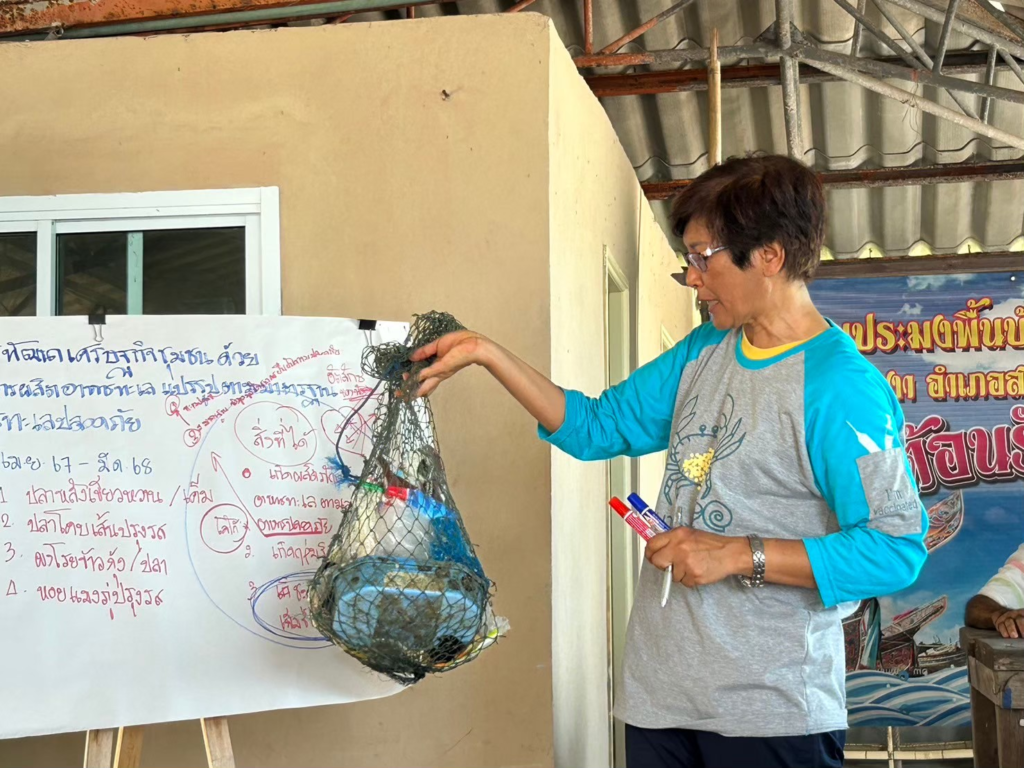
- Volunteer-based operations have been supported by long-term engagement. TSWA’s sustained presence in the region helped foster community participation. Leadership training and knowledge-sharing sessions were provided to empower local leaders to deliver waste management education throughout the community.
- Ongoing capacity building and technical assistance by TSWA have played an important role in raising awareness and strengthening community knowledge.
- Newly introduced collection routes have contributed to operational efficiency, helping increase recycling rates and reduce marine litter.
Key Challenges
- Initial awareness gap: At the start of the initiative, the two fishing communities had not yet been widely introduced to formal SWM systems. This highlighted the need for dedicated education efforts and long-term behavioural change initiatives.
- Maintaining consistent participation: Sustaining active involvement from all members beyond the initial enthusiasm remains an ongoing challenge and requires continuous community engagement.
Resources
- Support and infrastructure: WWF provided support for the new warehouse that was built for permanent waste bank operations in Baan Talae Nok. Equipment such as waste bags, a scale, calculator, logbooks, receipt books were supplied to both communities to assist with operations.
- Human resources: Baan Talae Nok has 13 committee members, 20 volunteers, and seven advisors (SD39 Group and PXP Sustainability, 2025).
Partnerships: TSWA implemented the initiative, established the waste bank, and provided technical and managerial support, while Siam Natural Group (a local junkshop) and Wongpanit (MRF), trained the communities on how to sort waste, ensuring a market for collected waste.
Enabling Factors
- Initial financial support from WWF enabled the establishment of a permanent waste bank warehouse.
- Technical support and training from TSWA facilitated the introduction of structured collection systems and laid the foundation for sustainable operations.
Risks & Opportunities
- Dependence on dedicated community leadership: The success of the initiative currently hinges on a small group of highly engaged leaders, which could affect continuity if leadership transitions are not planned. Continued engagement of other potential leaders in the community is key for sustained operations.
- Shareholder investment model may not suit all communities: The approach may need to be adapted in areas where a shareholder model is less culturally or socially accepted – community stakeholder consultations should be conducted prior to any replication of this model.
- Behavioural change and communication with the community should be encouraged with local government’s efforts and/or incentives.