Case Study
Thailand: Hat Yai
WWF Involvement: October 2023 to October 2025
Focus Area: Collection
PSC Approach: Formal Collection
Systemic Intervention: Policy Advocacy
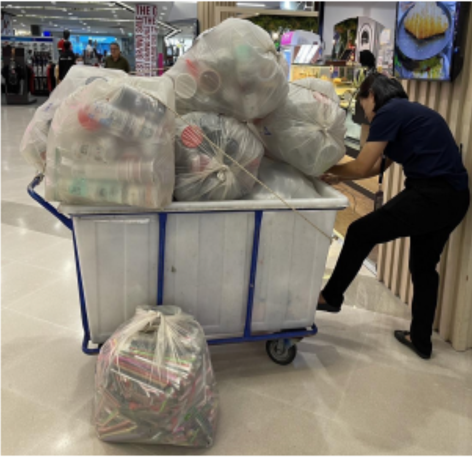
© WWF-Thailand
Key Lessons Learned
- Financial incentives can effectively support sustainable practices: Generating revenue from waste sales highlights the financial viability of structured recycling programmes. Monetising waste streams through certified processing and established market linkages can help secure long-term sustainability.
- Convenience and ease of use significantly influence participation levels: When waste collection systems are simple and clearly structured, staff participation increases. Conversely, systems that are complicated or inconvenient – such as the drop-off system introduced at the mall, which housekeeping found difficult compared to the previous mixed-waste approach – risks lower participation.
- Alignment between policies and implementation helps ensure sustainability: Although the project is aligned with municipal action plans, consistent enforcement and stronger governmental engagement are important factors to improve and maintain long-term results.
- Clear and intuitive communication encourages proper waste separation practices: Public awareness of correct waste separation can be improved by using clear, colour-coded bins with visual instructions and strategic placement. Additionally, ongoing training and regular monitoring of staff can further reinforce effective separation practices.
Background
In order to move away from mixed collection and enhance plastic recovery from the waste generated at Hat Yai’s Central Mall, the shopping mall adopted a “take-back” programme in October 2023, set to run until October 2025. In preparation for the adoption and enforcement of an Extended Producer Responsibility (EPR) Law, recyclable plastic and low value plastics packaging (such as coffee cups, straws and lids), the Central Mall acts as a collection point for these waste streams. Waste from the mall is then collected and processed at five Material Recovery Facilities (MRFs).
Objective
- Integrate Extended Producer Responsibility (EPR) principles by capturing recyclable waste within the system and ensuring proper separation and processing.
Key Successes
- Over 28.5 tonnes of plastic packaging was recovered between October 2023 and December 2024 (WWF KII 07, 2024).
- Strategic partnerships and institutional support: The initiative successfully signed an Action Plan with the municipality of Hat Yai, and Memorandum of Understanding (MoU) between O-Cyco (recycler) and Central Hat Yai Mall, with the municipality acting as a liaison, strengthening public-private collaboration.
- Increased recycling and waste capture: The project has facilitated the structured collection of recyclable waste, ensuring it is sold to MRFs for processing, including EPR waste.
- Integration with municipal waste management and certification: Waste management practices in the mall have been improved, contributing to better environmental performance indicators. Central Group’s mall performance framework dedicates 80% of its evaluation to environmental management, including waste and energy management (WWF KII 07, 2024).
Key Challenges
- Awareness and knowledge gaps: Housekeeping staff found the drop-off system challenging, particularly when identifying which waste could be sold or repurposed. Despite awareness-raising activities, customer understanding of proper waste separation remains relatively low.
- Storage and transport constraints: The mall currently has limited space for storing waste, and transporting waste to the five MRFs presents logistical challenges due to the distance. Waste is collected on a biweekly schedule.
- Seasonal waste generation fluctuations: Waste volumes increase substantially during festival periods, creating challenges for timely collection and processing. Outside of these periods, recyclable waste collected monthly typically ranges from 1 to 2 tonnes.
- Uncertain market for recycled glass: Although the project aims to recover all recyclable materials, glass recycling remains challenging due to inefficiencies in the contracted glass recycling facility.
- Administrative delays: A change in the mall’s general manager in October 2024 resulted in delays to the review process, affecting timely decision-making and procedural improvements.
Resources
The initiative is a collaboration between the municipality of Hat Yai, Central Hat Yai and O-Cyco (an ocean bound plastics recycling company), with support from Wongpanit and multiple MRFs.
WWF’s role: Facilitate coordination and collaboration between the municipality and private sector stakeholders; drive the management of plastic waste within the shopping centre to enhance the recycling rate of plastic items throughout the value chain, from materials offtake to consumption within the shopping centre.
Infrastructure and logistics: 30 bins have been placed inside and outside the mall for waste separation. Wongpanit provides transportation to the MRFs.
Human resources and training: Training was provided to mall staff and housekeepers on EPR principles and waste separation. Community awareness-raising efforts were conducted for mall customers.
Enabling Factors
Linking the Central Mall with private MRFs connects the different stages of the value chain, from generation, collection to recycling, consequently increasing the recycling rate.
Risks & Opportunities
- Price stability for recycled plastic: Due to the low price for plastic materials, many MRFs in Thailand are only able to remain viable when they access premium international markets. The offtaking of materials from the Central Mall to the MRFs therefore depends on the MRF’s ability to financially sustain their operations, which can be difficult if the input materials are not of high quality. Role of local and national government is needed for price stabilisation or incentive mechanisms. Additional efforts could be made to improve the quality of materials.
- Scale requires government uptake: While this initiative is aligned with the municipality’s action plan, the absence of a designated municipal civil servant to oversee and actively support the implementation process has made it more challenging to maintain momentum and fully realise the initiative’s intended impact. There is potential to scale these initiatives with added personnel for oversight.