According to the Global Plastic Action Partnership, approximately 627,000 tonnes of plastic waste was generated in Ecuador in 2022. Although 8% was effectively recycled with 87% collected, an estimated 40%, equivalent to approximately 250,000 tonnes, was ultimately mismanaged, increasing the risk of leakage into the environment and harm to human health and ecosystems. Furthermore, Ecuador’s National Plan for the Reduction of Plastic Waste indicates that more than 80% of the country’s plastic waste comes from the packaging sector.
Voluntary Extended Producer Responsibility for Packaging and Containers
Recognising the challenges, Ecuador has been developing a voluntary Extended Producer Responsibility (EPR) initiative for packaging and containers, with the program designed in two phases – feasibility study and piloting, which allows for the assessment of operational models, followed by the testing of the workflow and organisation of responsibilities, the mobilisation of financing, and the creation of collective infrastructure to recover post-consumer materials.
The first phase (August 2025 – May 2026) consisted of a financial and operational feasibility study, led and funded directly by a consortium of major companies from the food and beverage and packaging sectors. WWF Ecuador, through the National Plastic Action Partnership (NPAP) Ecuador, provided technical assistance and facilitated coordination between the private sector and public authorities. The Ministry of Environment and Energy, as well as the Ministry of Production, Foreign Trade and Investments, actively participated in the development of the study through working sessions and providing feedback on its findings.
This institutional participation has been essential because the initiative is not intended to remain an isolated voluntary exercise. The main objective is to generate practical evidence, lessons learned, and operational data that can inform the development of Ecuador’s future national EPR policy and regulatory framework, in which, participating companies can contribute to the system design before the regulatory obligations come fully into effect.
Key Lessons from a Feasibility Study Conducted for Implementing EPR Policy and Regulatory Framework
The study finds that Ecuador already has a regulatory framework that lays the groundwork for a specific EPR regulation for packaging. However, the main barriers to its effective implementation are the lack of reliable operational data and limited shared infrastructure for collection, sorting, traceability, and recovery. The study highlights the following key lessons:
- Targets must be evidence-based, progressive, and differentiated by material type. Recovery targets should reflect actual collection, sorting, recycling, and market capacities. Setting ambitious targets without reliable data or sufficient infrastructure could increase costs without delivering measurable environmental results.
- Traceability must be a core component of the system. Common standards are needed to verify material flows from collection to recycling or another authorized destination. Payments and the recognition of recovery results should be linked to verified services and traceability records.
- The inclusion and formalization of waste pickers must be a central objective of the EPR system. Their inclusion must go beyond recognizing their contribution. The regulation should establish concrete pathways for formalization, fair remuneration, stronger organizational and technical capacities, improved working conditions, and effective participation in the system’s governance and operation.
- Companies have an opportunity to anticipate and inform future regulation. By jointly designing and testing a collective recovery system, producers can generate real operational and financial evidence to help shape an EPR regulation that responds to Ecuador’s national context and to the different infrastructure, recovery, and market gaps in each territory
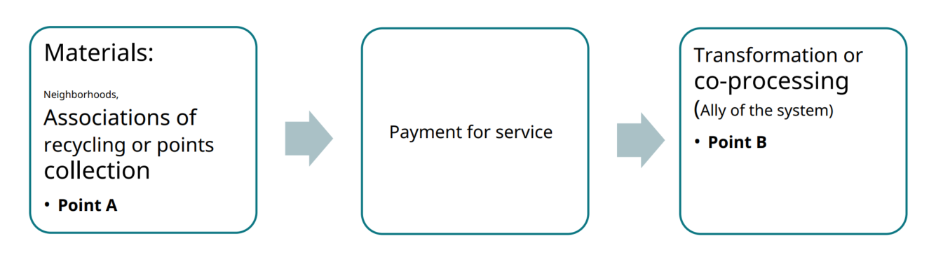
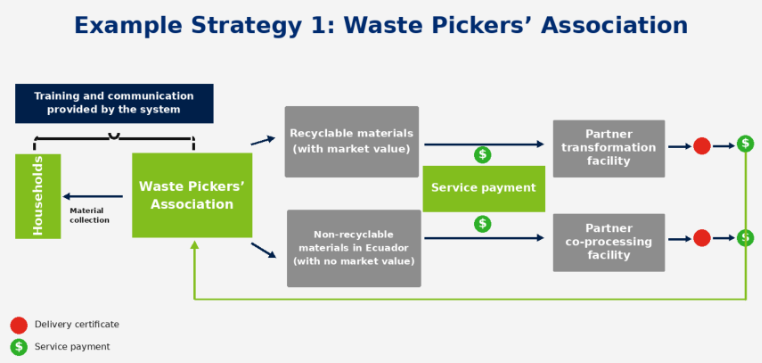
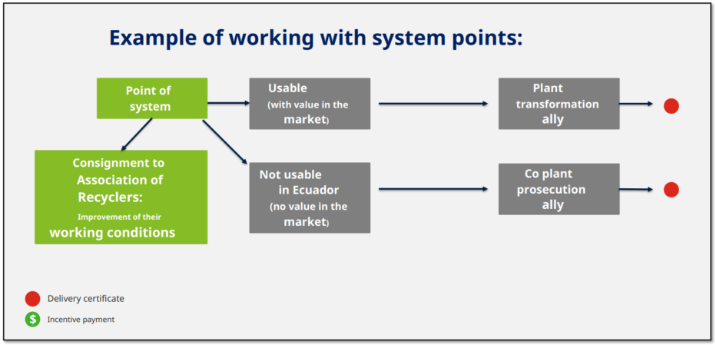
Through the feasibility study, an operational workflow has been defined and recommended for Ecuador’s context, where the collection service will be financed to strengthen the recycling chain= this will be piloted in the next phase of the initiative. Based on its annual targets, the industry-led EPR system requests the collection of specified types and quantities of recyclable materials from recycling associations. It provides financial support to strengthen the recycling value chain once the materials have been delivered to a designated recycling or co-processing partner, and the corresponding traceability certificate has been verified. The system does not engage in the commercial purchase or sale of recyclable materials, serving instead as a mechanism to incentivize collection and ensure material traceability. Higher incentives are provided for materials that are not typically collected by waste pickers and would otherwise end up in landfills, compared with materials that already have a high market value, thereby prioritising their collection.
Second Phase: Piloting the EPR Operational Workflow
The Ministry of Environment and Energy as well as the Ministry of Production, Foreign Trade and Investments have continued to be key partners throughout the pilot phase.
The pilot is being developed in coordination with associations of waste pickers and grassroots recyclers, the municipalities of the three participating cities, and companies that process and transform recovered plastic materials. Strengthening material traceability and ensuring that the information generated can be validated and used by public institutions will be key priorities during the second phase.
Between May and July 2026, the efforts focused on securing the financial commitments and partnerships needed to support the implementation and long-term sustainability of the initiative. Commencing in August 2026 and expected to run for one to two years, the financial and operational model will be piloted in three cities: Cuenca, Salinas, and Quito, to assess its feasibility and effectiveness. The implementation will continue to be supported primarily by the participating companies, with additional private-sector partners joining the initiative to strengthen its implementation and long-term scalability.
WWF-Ecuador, together with a private sector representative from the nation participated in a WWF-organized EPR learning exchange in Chile in May 2026, gaining insights from a successful EPR scheme in the neighbouring country. These takeaways hope to strengthen their system, keep up the momentum, as well as share progress and lessons as the process advances.