Case Study
Singapore
WWF Involvement: 2024 – September 2026 (including programme development phase and Piloting phase from April – September 2026)
Focus Area: Reduction
PSC Approach: Behavioural Change; Collection; Reuse
Systemic Intervention: City Systems & Planning; Systems & Infrastructure; Knowledge Strengthening; Strategy Development
For more information, contact:
Mr. Goh Ter Yang | WWF-Singapore
Email: tygoh@wwf.sg
Website: https://plastic-action.asia/transforming-fb-packaging/
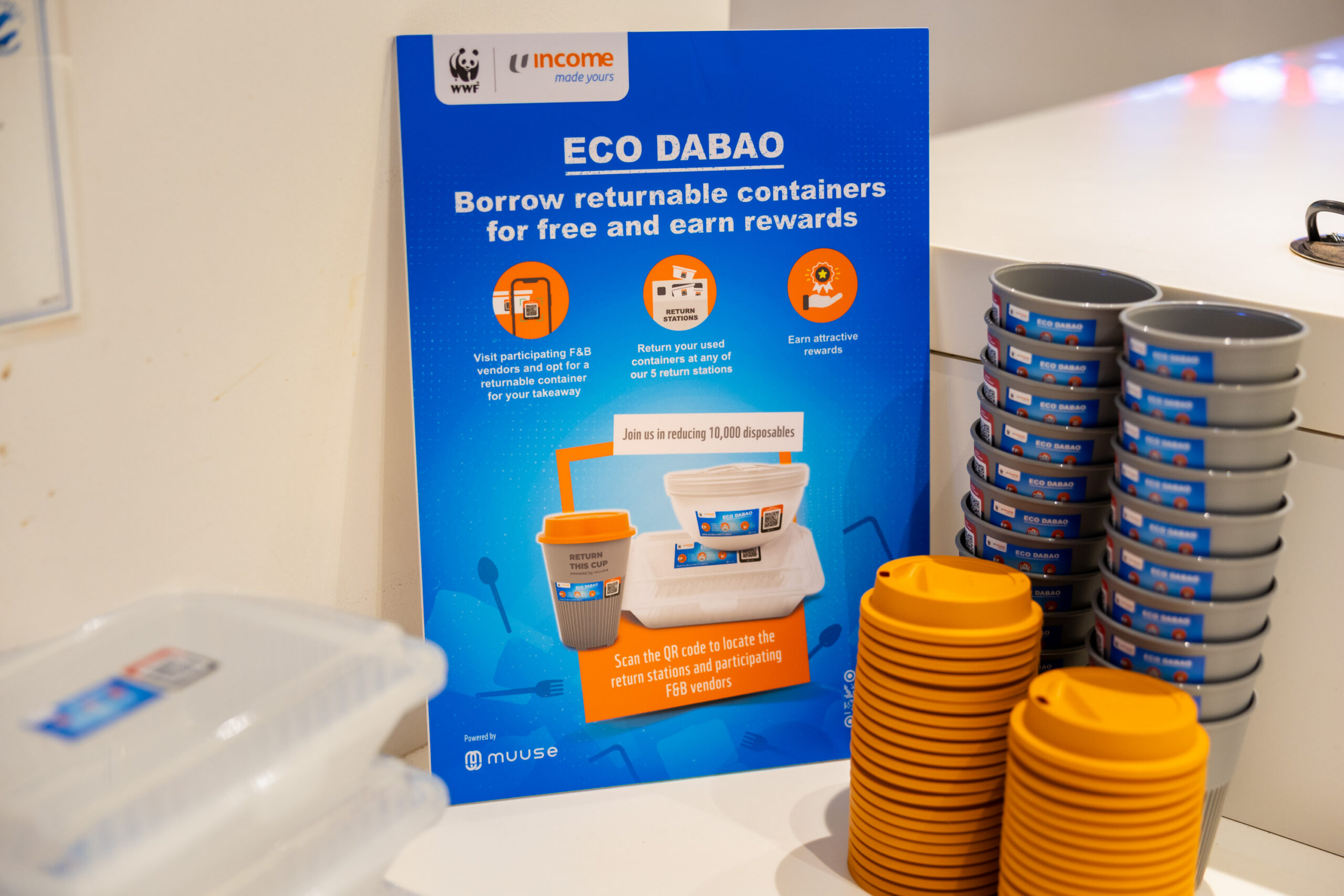
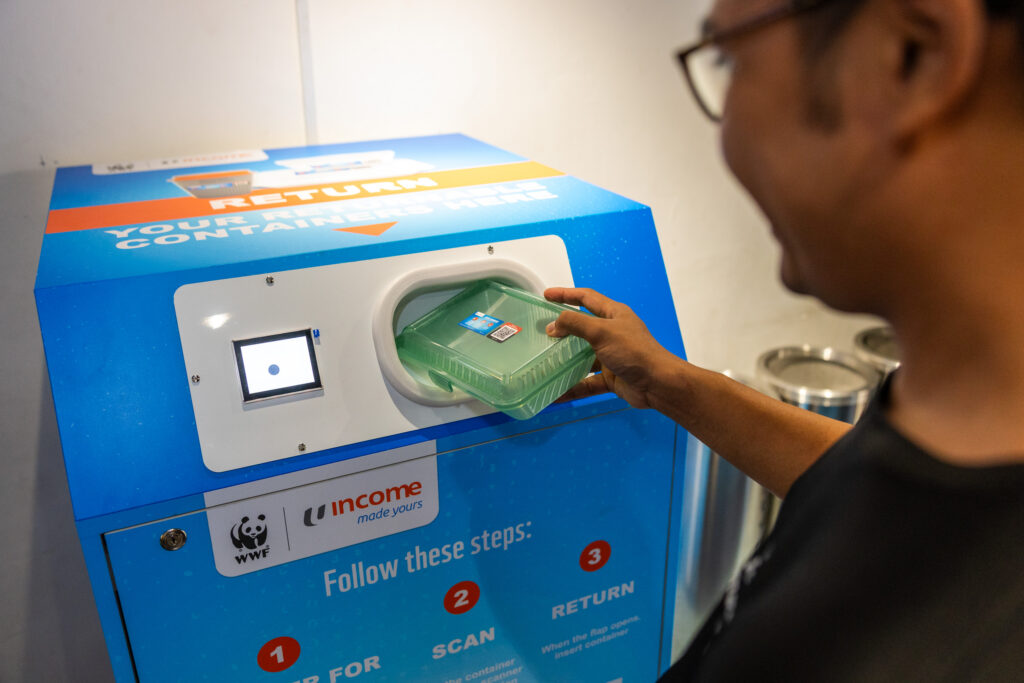
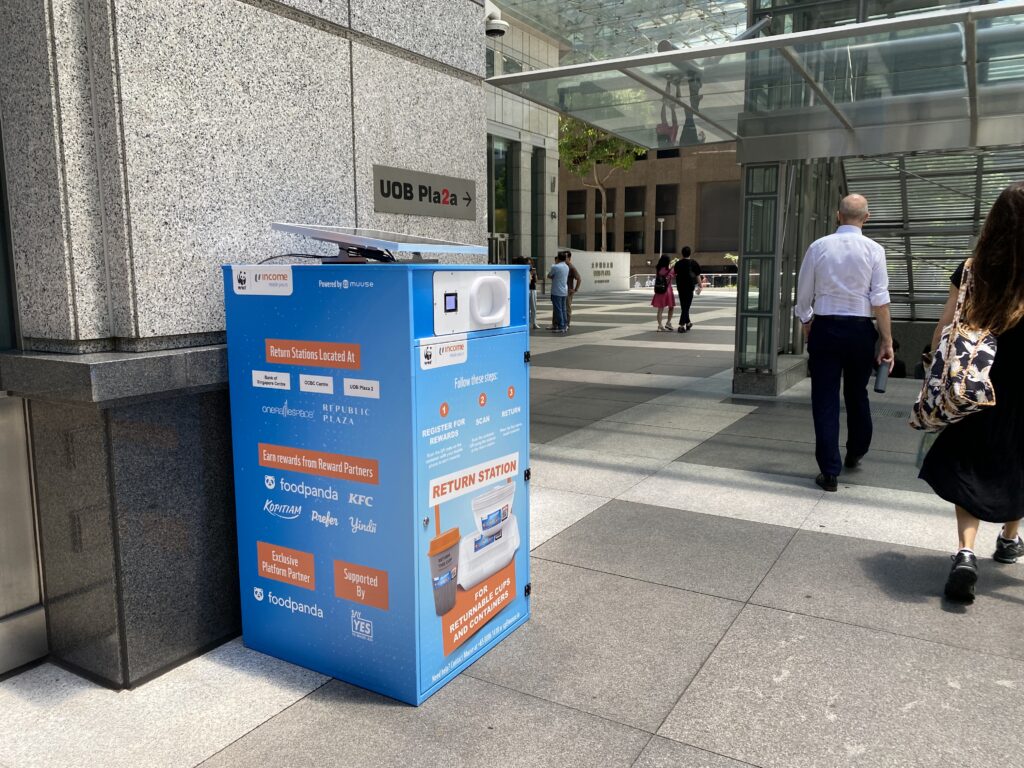
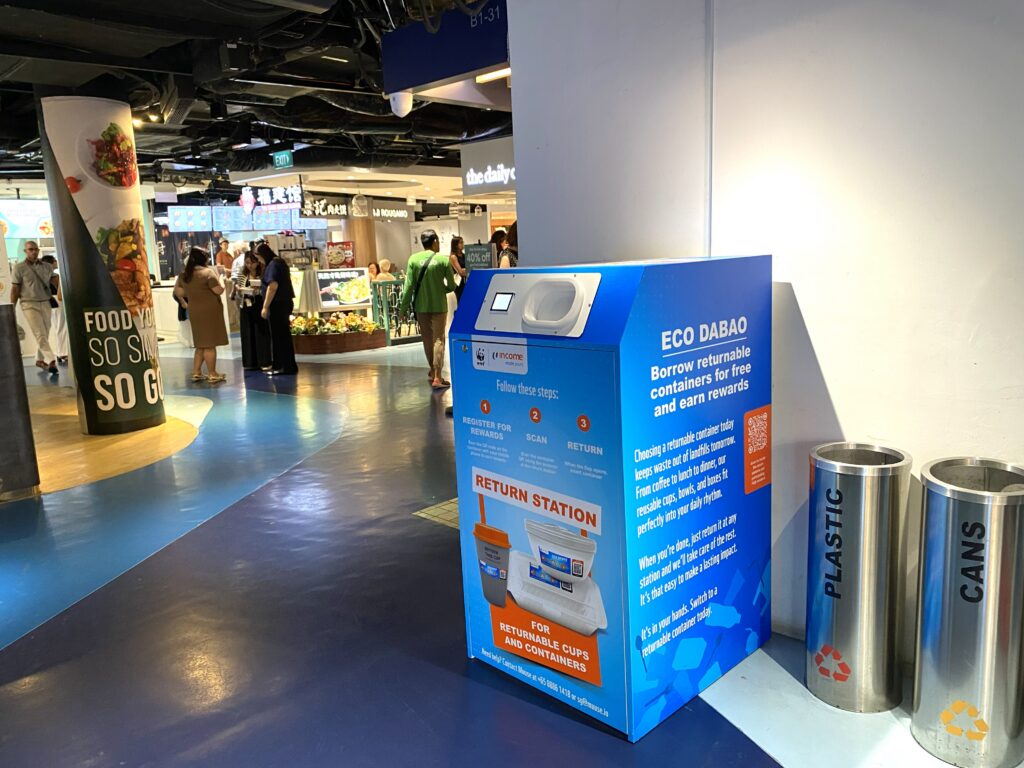
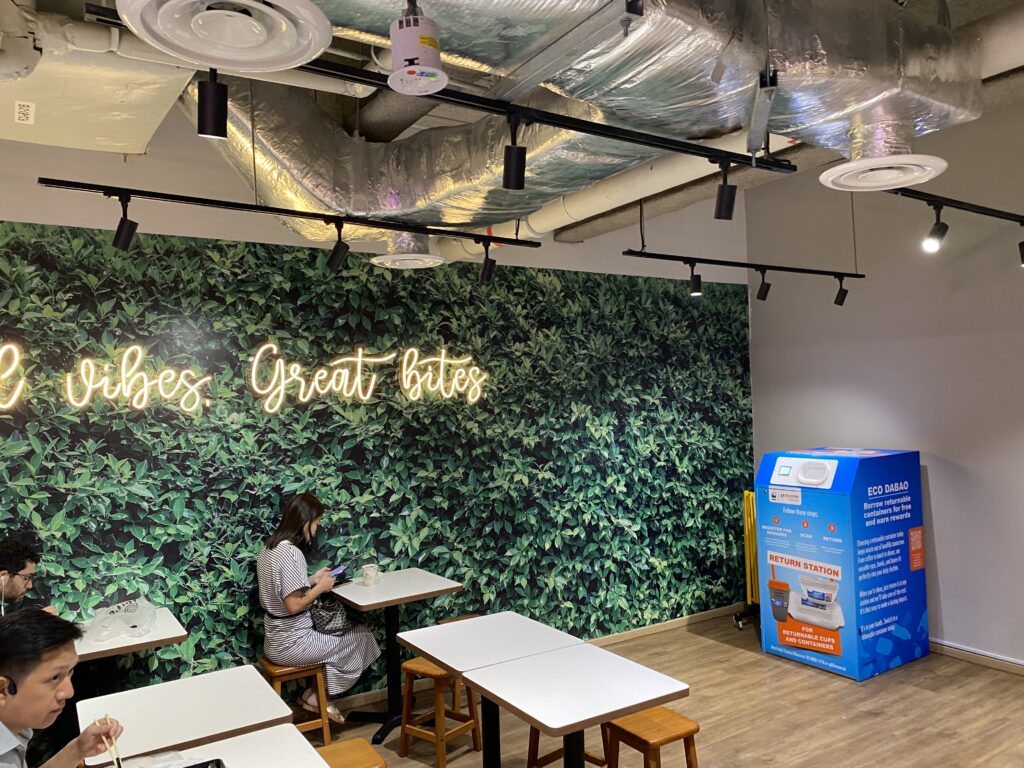
Return Station © WWF-Singapore
Key Lessons Learned
- Start with the food outlets, not the buildings
- F&B operators hand out the containers every day, so their buy-in shapes the whole experience. In Phase 1, property partners were secured first, leaving outlets only about a month to train staff and adjust their workflows. Merchants found that simply making reusable containers available was not enough – staff also needed to encourage customers to try them, including during busy lunch periods. Engaging outlets earlier would give them more time to prepare and help build a stronger sense of ownership.
- Convenience and density drive participation – drawing from merchant feedback and implementation, consumers are significantly more likely to participate when borrowing and return processes are simple, visible and integrated into existing routines. Reuse systems should focus as much on convenience and user experience as on environmental messaging.
- Customers who used Eco Dabao valued being able to return containers at any station rather than the outlet, and found the microwave-friendly containers convenient for reheating meals, while those who held back cited the added effort of finding a participating outlet and return point and hygiene concerns as deterrents.
- While environmental awareness may influence willingness to try the system, participation appeared to increase when borrowing and return processes were easy to understand and integrated into existing routines.
- Concentrating outlets and return points within a smaller area first can make reuse the easy choice. A sustainable option is more likely to be adopted when it is also the easiest option available.
- Reuse systems require ecosystem thinking
- Success depends not only on consumer behaviour but also participation from technology partners, logistics providers, property owners, food vendors, and funders. A reuse system is only as effective as the network supporting it and will not succeed based on consumer behaviour alone.
- Infrastructure, logistics, technology, stakeholder alignment and operational support all played critical roles in enabling participation. The project highlighted that reuse systems function as ecosystems, and their effectiveness depends on the strength of collaboration across multiple stakeholders.
- Assess uptake alongside container availability
- Utilisation depends on having the right type of container at the right outlet at the right time. In Phase 1, stock was allocated in response to outlet requests, and natural variations in demand sometimes led to short-term shortages of certain container types. As customers were not required to register their borrows and returns, it was also harder to anticipate when containers would come back into circulation. Building on this experience, the next phase will link every borrow to a user profile, carry out regular stock checks reconciled against system data, and allocate containers based on closely monitored local demand.
- Pilots Generate Value Beyond Immediate Environmental Outcomes
- Implementation generated practical insights into consumer behaviour, infrastructure placement, operational requirements, stakeholder engagement and system design, providing knowledge for evidence-based scaling of reuse systems. These lessons directly informed discussions around future programme improvements and contributed to the development of the Phase 2 model.
Background
Singapore generates substantial volumes of takeaway packaging waste every year, much of which originates from daily food consumption habits. While reusable packaging solutions have existed in closed environments such as offices, schools and events, there has been limited testing of an open-loop, district-wide reuse system operating across multiple buildings, tenants and food outlets.
To explore how reuse systems could function at a larger scale within Singapore’s urban environment, WWF-Singapore partnered with Muuse – an environmental services company – and Income Insurance to launch Eco Dabao (colloquial for ‘Eco Takeaway’), Singapore’s first precinct-scale return-and-reuse takeaway packaging system in the Central Business District (CBD).
Unlike outlet-specific reuse programmes, Eco Dabao was designed as a shared ecosystem spanning multiple food and beverage operators, office buildings and return locations. Consumers could borrow reusable food containers for takeaway meals and return them at designated return stations located across participating CBD locations, removing the need to return containers to the original point of borrowing.
Objectives
- Pilot Singapore’s first district-scale return-and-reuse takeaway packaging system.
- Avoid 3,000 disposables in the CBD. Understand consumer adoption, usage and return behaviours in an open-loop reuse environment.
- Test the operational feasibility of a shared reuse ecosystem involving multiple stakeholders.
- Generate evidence and lessons to inform future scaling and replication efforts in Singapore.
- Build awareness and acceptance of reusable packaging among office workers, food vendors and building stakeholders.
Key Successes
- Demonstrated a Working Shared Reuse Ecosystem
- Eco Dabao successfully brought together funders, property owners, food and beverage operators, logistics providers, and consumers within a single reuse system – this included a diverse network of stakeholders, including Income Insurance, WWF-Singapore, Muuse, five property locations, incentive partners, and consumers, along with nine participating food and beverage outlets, which grew to 13 outlets with none leaving the programme.
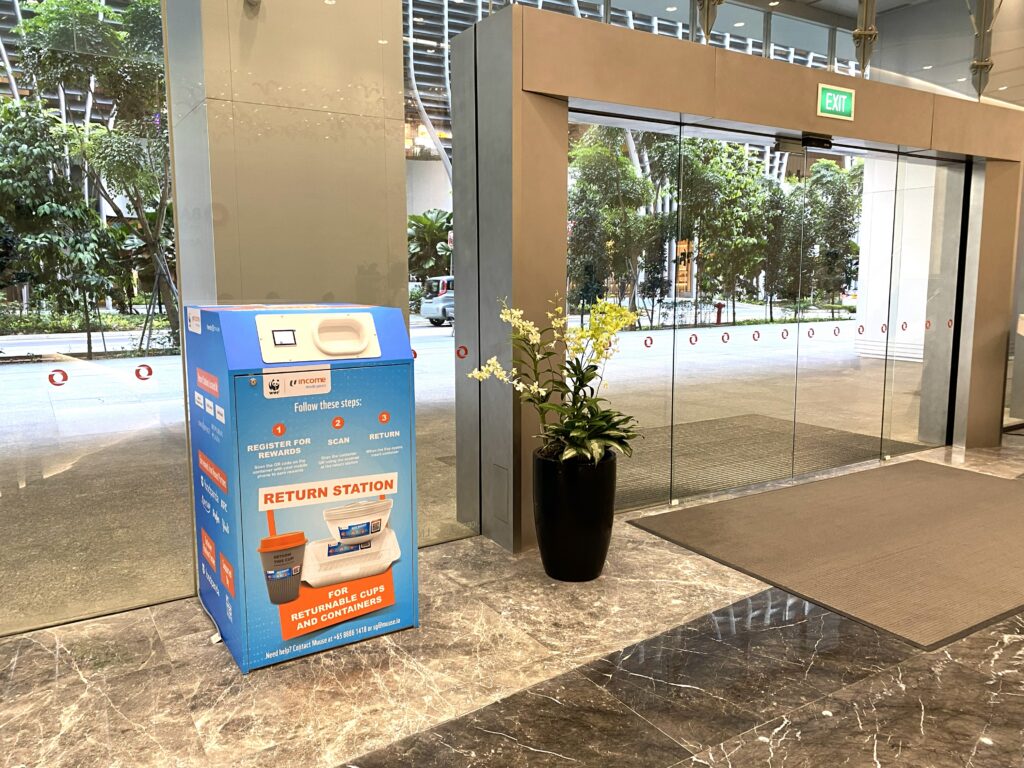
- Through the partnership, WWF-Singapore and Muuse established five return stations across major office properties in Singapore’s CBD, creating the infrastructure needed for users to borrow and return containers across multiple locations.
- Generated Measurable Impact and Valuable Real-World Behavioural Insights
- WWF-Singapore recruited property, F&B, and reward partners directly, and promoted the service through public events, workplace talks, on-site signage, and promoters, and an industry showcase. While participation cannot be attributed to any single activity, these efforts collectively increased visibility among office workers and building occupants.
- During the piloting period from 22 April to 21 September 2026, 2,346 containers (food and beverage packaging) were circulated using 1,122 unique containers. The pilot achieved users scanning 899 containers borrowed, with a 92% return rate (831 containers) to the 5 return stations located in the CBD.
- Early Signs of Behavioural Change
- Of the 360 people who borrowed containers, 75 became repeat users. This group, around one in five users, accounted for 60% of user-linked borrows, with one user borrowing 35 times. The rewards system was designed to encourage people to return containers and borrow again, yet very few vouchers were redeemed, suggesting that this repeat use was driven mainly by personal motivation rather than incentives
Key Challenges
- Achieving Network Density and Scale
- Reuse systems become more convenient and effective as the number of participating outlets, return points and users increases. During the pilot phase, though the number grew, the concentration of participating vendors and return infrastructure remained limited, affecting system utilisation and visibility.
- Friction in Borrowing and Returning
- Customers needed to locate a participating outlet, identify a nearby return point and understand how the borrow-and-return process worked. Merchants reported that some customers saw returning a container as an extra errand, even with return points available, while others were concerned about hygiene because the containers are used. Any additional registration requirements, application downloads or learning steps reduced participation among casual users who prioritised convenience.
- Limited Consumer Awareness
- During Phase 1, WWF and Muuse introduced additional signage, workplace engagement sessions, promoters and outreach activations specifically because awareness and discovery emerged as recurring challenges during implementation. Despite communications and outreach efforts, many potential users were still unaware of the programme or encountered it only occasionally. Sustained visibility and repeated exposure are critical for behaviour change within busy urban environments.
- Operational Constraints Among Small Vendors
- Many food vendors operate from compact premises with limited storage capacity. Managing reusable container inventory alongside daily operations created practical challenges that influenced participation and uptake.
Resources
- Funding support from Plastic Solutions Fund (PSF) and WWF’s Plastic ACTion (PACT) initiative, and Income Insurance.
- Muuse provided the technology platform, reverse logistics system, cleaning, container redistribution, rewards platform and customer support
- WWF-Singapore provided project management and stakeholder coordination.
- Participation from property owners and building managers.
- Engagement of food and beverage operators.
- 3,000 reusable cups, bowls, and food containers
Enabling Factors
- Strong cross-sector collaboration between NGOs, businesses and property stakeholders.
- Existing concentration of office workers and food outlets within the CBD.
- Shared infrastructure that allows flexible container returns.
- Growing public awareness of waste reduction and circular economy solutions.
- Availability of an experienced implementation partner capable of managing logistics and sanitisation.
- Commitment from partners to continue testing and refining the model beyond the pilot phase
Risks & Opportunities
Risks
- Continued reliance on external funding.
- Insufficient density of vendors, return points and active users to make reuse a convenient daily habit.
- Operational complexity in collection, cleaning, redistribution and stock management, including container availability and hygiene assurance.
- Changes in stakeholder participation over time, particularly as the vending-machine model remains exploratory and depends on locations, vendor acceptance and return arrangement.
Opportunities
- Muuse-led Phase 2, exploring vending machines so customers can pick up a container before choosing where to eat.
- Integration with additional buildings and food operators: Potentially in the existing Raffles Place zone, or the neighbouring Marina Bay zone within the CBD.
- Stronger digital integration and reduced onboarding friction: Integration between user accounts on the Muuse app and various reward partners to make redeeming of rewards more seamless.
- Replication in other business districts and precincts: For example, One-North in Buona Vista in the west of Singapore, or Punggol Business District in the northeast of Singapore.
- Development of evidence to support wider reuse strategies and policy discussions in Singapore: In support of Singapore Green Plan’s pillar on Sustainable Living – A Green Citizenry That Consumes and Wastes Less.