Case Study
Greece: Nationwide
WWF Involvement: Policy design 2025–2026; proposed phased implementation 2027–2030
Focus Area: Enabling Framework; Reduction
PSC Approach: Local Policies and Regulation; Sustainable Financing; Monitoring & Evaluation
Systemic Intervention: Policy Advocacy; Financing & Funding Mechanisms; Knowledge Strengthening
For more information:
Website: https://www.wwf.gr/en/get_involved/campaigns/butt_off/
Key Lessons Learned
- Litter prevention first
Extended Producer Responsibility (EPR) for cigarette butts is primarily a litter-prevention and cost-recovery instrument – recycling alone cannot define success. Clear secondary legislation and a national baseline and monitoring protocol are needed to turn EPR obligations into measurable litter reduction.
- Transparent, evidence-based fees
Fees must be based on costs that are necessary, efficiently provided and transparent, such as street, beach and park cleaning, collection and transport of butts, bin installation and maintenance, awareness campaigns and data monitoring, supported by reliable public-space litter data. They should ensure full cost coverage, allocate funding based on verified municipal costs and tourism/coastline pressure, and be reviewed periodically alongside targets.
- Independence and enforcement
Independence, open data and meaningful enforcement are essential to avoid industry capture and free-riding. This requires independent Producer Responsibility Organisation (PRO) governance, audited reporting and strong legal enforcement.
- Build on proven international practice
WWF Greece benchmarked Sweden, France and Spain (cost recovery, targets, reporting, governance and sanctions), as well as Denmark’s per-filter fee, local “litter levies” in London and San Francisco’s Cigarette Litter Abatement Fee. Effective schemes share five features: full cost recovery, quantified reduction targets, graduated fee adjustment, independent governance and a rigorous control mechanism. In France, the Council of State annulled parts of the scheme in 2024, partly because the PRO was not independent enough from large producers.
Background
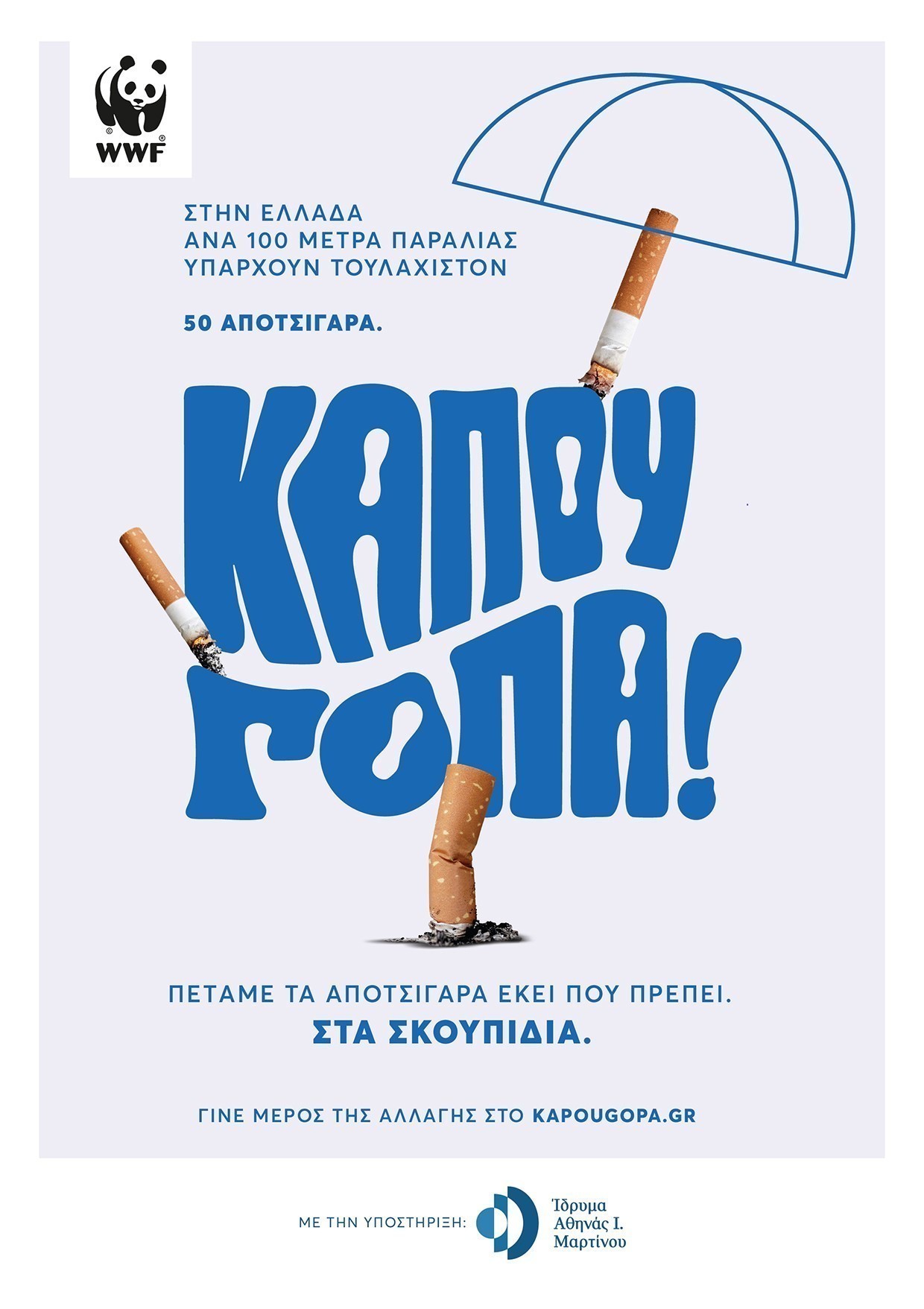
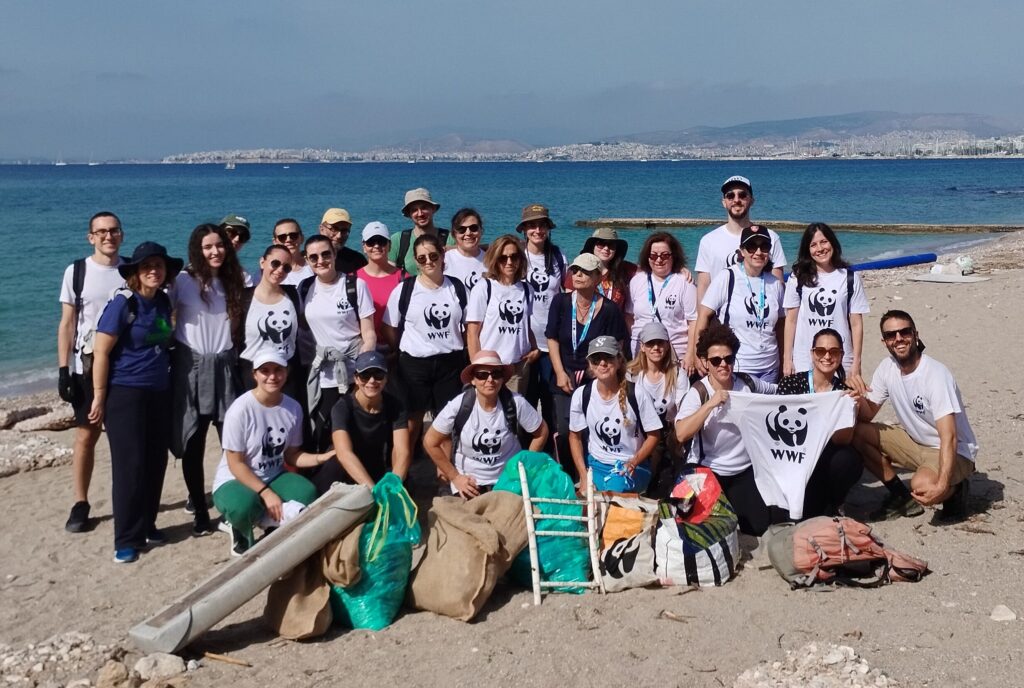
Cigarette butts are among the most persistent litter items on Greek beaches and in public spaces. The scale of the problem is significant. Cigarette butts are the number one plastic litter item on Greek beaches, with at least 50 butts per 100 m of beach. WWF Greece’s “Adopt a Beach” citizen-science monitoring records an average of over 400 butts per 100 m sample, and single recordings of more than 8,000 butts across 100m. Around 14.85 billion cigarettes were consumed in Greece in 2023 (KPMG), equivalent to roughly 3,000 tonnes of cigarette butts a year.
Filters containing cellulose acetate are single-use plastic products under Directive (EU) 2019/904, which requires producers to cover the costs of awareness raising, public collection systems and litter clean-up. Greece transposed the Directive through Law 4736/2020, while Law 4819/2021 provides the wider framework for producer responsibility systems, oversight and sanctions. The EU deadline for an EPR scheme for tobacco filters (5 January 2023) has passed, but Greece had implemented only the labelling requirement and the general sanctions framework. No producer collection system had been set up, leaving clean-up costs with municipalities and exposing Greece to EU infringement proceedings.
In response, WWF Greece developed and published a policy-ready EPR proposal for tobacco products with plastic filters in October 2025, “For a Greece without cigarette butts everywhere”. It was built through legal review and international benchmarking, market and cost analysis, and the design of governance, financing, monitoring and municipal reimbursement mechanisms. The EPR proposal was developed to turn above-mentioned legal obligations into a practical, transparent and enforceable national system.
If fully implemented, the scheme is expected to reduce cigarette-butt litter by expanding collection infrastructure, funding regular clean-ups, holding awareness campaigns on correct disposal, and raising producer fees by up to 50% if reduction targets are missed. It would also ensure that producers cover the costs of public clean-up, strengthen municipal capacity, improve monitoring and data collection, and create incentives to reduce the environmental footprint of tobacco products with plastic filters.
Objectives
- Make producers/importers finance the full necessary costs attributable to cigarette-filter litter.
- Reduce cigarette-butt litter by 30% by 2028 and 50% by 2030 against a national baseline.
- Create transparent municipal reimbursement, monitoring and enforcement mechanisms, while ensuring the PRO is operationally independent from tobacco-industry commercial interests.
Key Successes
- Policy proposal has influenced draft Ministerial Decision: Although the EPR scheme has not yet been implemented, WWF Greece’s policy proposal has already had a tangible impact on the regulatory process: WWF Greece successfully influenced the draft Ministerial Decision establishing the national EPR scheme for tobacco products with plastic filters. Around 60% of the recommendations in WWF Greece’s policy proposal were reflected in the draft – particularly on producer obligations, litter reduction targets, collection infrastructure, cooperation with local authorities, public awareness and monitoring provisions – a significant contribution to shaping the national regulatory framework.
- Comprehensive design for EPR implementation: the policy proposal provides a comprehensive, costed blueprint for strengthening governance, transparency, financing and accountability as the scheme moves towards implementation. It covers the legal architecture and financing model, governance and conflict-of-interest safeguards, municipal reimbursement rules, a monitoring methodology for beaches, roads and parks, data and reporting requirements, compliance controls and sanctions, and a phased implementation roadmap. Its economic analysis of clean-up costs for about 1,800 km of accessible coastline, urban areas and parks (€119–293 million a year under low, medium and high scenarios) shows that the per-filter fee could raise about €211–282 million a year – enough to cover even the high scenario.
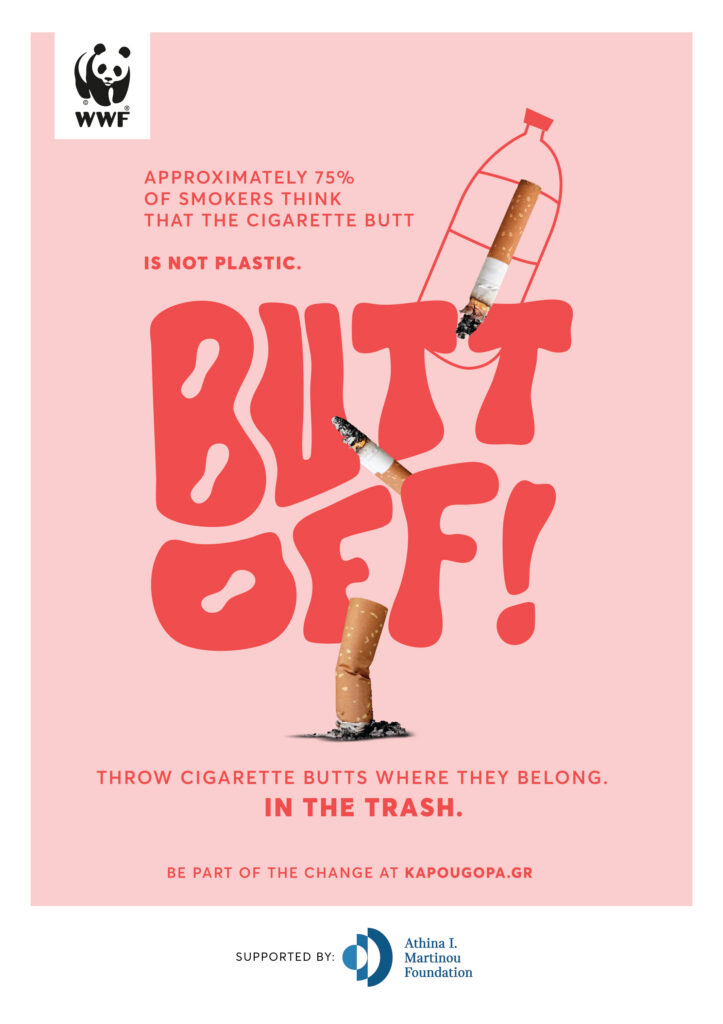
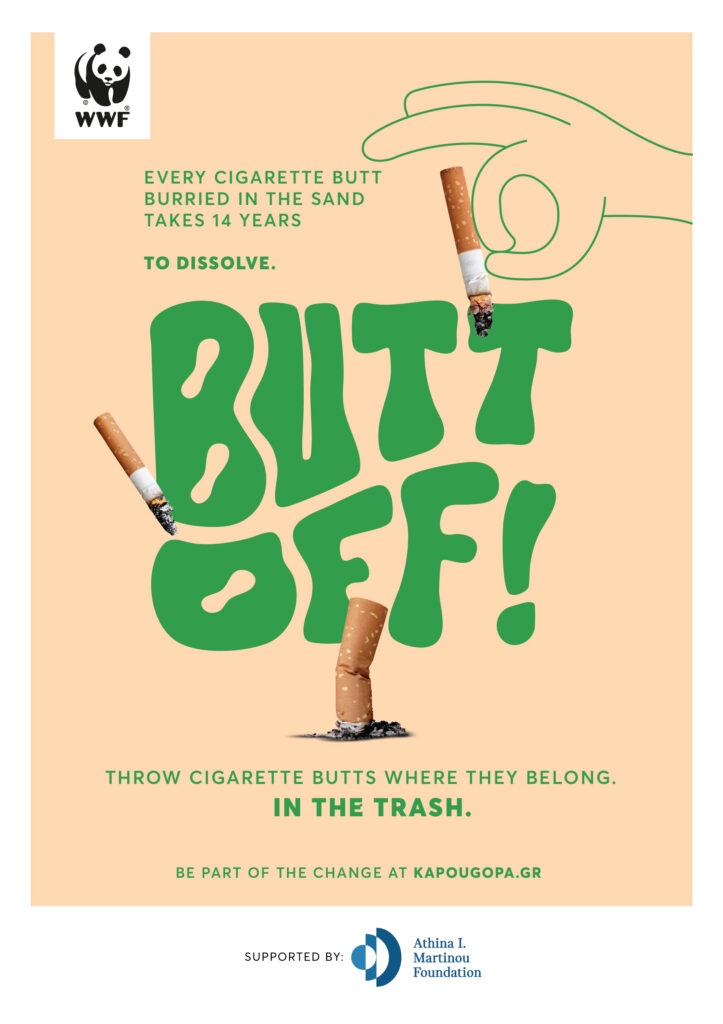
- Campaign materials developed to raise awareness of cigarette butt as plastic waste The BUTT OFF! (Kapou Gopa!) campaign materials, launched in 2025, were provided for municipalities, transport, hotels, bars and restaurants, universities and citizen groups; the campaign gained significant traction in traditional and digital media and extended its reach through local influencers and targeted digital advertising
Key Challenges
- Cost evidence: Greece lacks a single national dataset isolating cigarette-butt clean-up costs across beaches and urban public space.
- Governance risk: a PRO financed by producers must remain genuinely independent in decision-making and fee setting.
- Compliance and data gaps: filter-only importers and free-riders must be captured even where excise-duty data do not apply.
- Illicit trade and leakage: about 3.53 billion cigarettes (23.7% of consumption in 2023) were illegal, and filter-only businesses place over 1.5 billion filters a year on the market without paying excise duty. The fee therefore has to be tied to customs, track-and-trace and e-invoicing checkpoints.
Resources
- Donor: Athina I. Martinou Foundation.
- Project partners / target reach: Ministry of Environment & Energy, Hellenic Recycling Agency, municipalities, tobacco producers/importers, academia, civil society and consumers.
- Other institutional actors: Ministries of Finance and Digital Governance (co-signatories of the Joint Ministerial Decision) and the Central Union of Municipalities (KEDE).
- Data and expertise: WWF Greece’s “Adopt a Beach” citizen-science monitoring (since 2019, on more than 250 Greek beaches), and legal, market and cost analysis drawing on sources such as KPMG illicit-trade data and the Keep Britain Tidy and Rezero clean-up cost studies.
- Communications: BUTT OFF! campaign materials, media outreach, local influencers and digital advertising.
Enabling Factors
- Clear secondary legislation.
- Strong oversight by the Hellenic Recycling Agency.
- Reliable producer and customs data.
- Standard municipal cost reporting.
- Independent PRO governance.
- Political consensus.
- A transparent national litter baseline.
- A concentrated market: fewer than 30 registered producers/importers, with six groups accounting for over 95% of sales, so a single PRO is administratively manageable.
- An existing national monitoring protocol (“Adopt a Beach”) that lowers start-up costs and engages volunteers.
Risks & Opportunities
- Financing: surplus fee revenue can fund research into plastic-free filters and voluntary clean-ups, and “Adopt a Beach” is expanding to other Mediterranean countries (Turkey, Italy, Tunisia, Morocco and Libya), supporting replication.
- Potential ban: if a 50% reduction is not reached by 2030, the proposal states that a gradual ban on plastic filters from 2031 may follow.
- Replication: The approach is designed for national scale but is also replicable in Mediterranean countries facing high tourism pressure and cigarette-butt litter. The legal core derives from the EU Single-Use Plastics Directive; the financing and monitoring modules can be adapted to national market structure, municipal costs and coastline characteristics.
- Implementation delay risk: the EU deadline for an EPR scheme for tobacco filters (5 January 2023) has passed and the scheme has not yet been implemented. Until secondary legislation is in place, clean-up costs remain with municipalities and Greece remains exposed to EU infringement proceedings.