To advance circular economy solutions, WWF-Viet Nam, in collaboration with Hue University, launched a pilot Deposit Return Scheme (DRS) on 14 September 2025. DRS is widely recognized as an effective approach to complement Extended Producer Responsibility Schemes (EPR), especially in increasing the recovery rate of recyclable materials, including beverage containers.
Under this approach, consumers pay a small deposit when purchasing beverages in glass and plastic bottles or cans. After using the product, consumers return the empty container to a designated collection point and receive their deposit back. Hue is now one of the first cities in Southeast Asia to pilot this model, marking an important milestone for circular economy solutions in the region.
Deposit Return System to Increase Waste Collection
The pilot in Hue pursues several core objectives: to raise public awareness and shift behaviours, especially among young people, towards improving separation of waste at source. By providing reverse vending machines (RVMs), this initiative aims to encourage proper collection practices while also promoting responsible disposal by returning empty bottles to the collection point after use. For the pilot phase, from September to the end of 2025, an RVM was placed in Hue University and one at Nera Garden apartment complex. The machines are rented from BOTOL, a company that provides RVMs for plastic bottle recycling.
Every plastic bottle purchased at the university canteens and apartment mini-supermarkets are marked with a WWF barcode label. Consumers need to use an e-wallet account to receive their deposit after returning bottles to the designated machine. The deposit is set at VND1,000 (approximately USD0.038), and as an added incentive during the pilot period, consumers will receive an additional VND100 and have a chance to win at a lucky draw with gifts from WWF-Viet Nam, such as a notebook or a water bottle. Once collected, the bottles are then sold to recycling partners for processing.
With over 200 participants onsite engaged, the project also launched a public campaign titled “Smart Hue Citizens – Why Not Go Green?”. The campaign offered attractive incentives for the first 50 participants who tried reverse-vending machines and shared their experience on their personal social media pages to help amplify the initiative.
The launching events in both places attracted over 200 participants onsite and more than 300 engagements on social media. Furthermore, to build momentum, the project also launched a public campaign titled “Smart Hue Citizens – Why Not Go Green?”. The campaign offered attractive incentives for the first 50 participants who tried reverse-vending machines and shared their experience on their personal social media pages to help amplify the initiative.
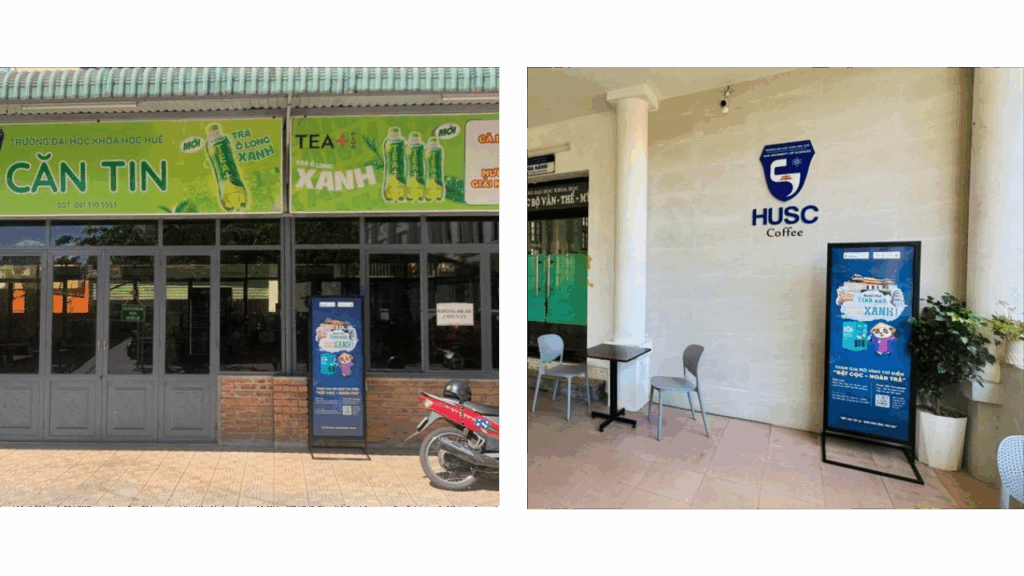
Hue University’s Canteen
Posters and promotions are displayed on-site at Hue University and Nera Garden building, as well as disseminated online through social media. By pairing hands-on participation with digital engagement, the initiative aims to normalize the habit of returning recyclable bottles and highlight the tangible benefits of closing the loop on beverage packaging.