City’s Economic and Environmental Landscape
The Metropolitan Area of Guadalajara (AMG), located in western Mexico in the State of Jalisco, is the second-largest metropolitan region in the country and one of Mexico’s leading economic, industrial, and technological hubs. It is composed of nine municipalities and is home to 5,243,392 inhabitants, concentrating more than 60% of the state’s population and generating approximately 5,100 tons of municipal solid waste per day. Plastic waste represents a significant fraction of this waste stream and holds high potential for valorisation. Rapid urban growth, territorial expansion, and increasing consumption patterns have intensified pressure on metropolitan infrastructure and environmental systems.
City’s Recycling Challenges: Infrastructure and Source Separation
Although waste collection coverage is considerable, most materials continue to be sent to final disposal sites, and formal recycling rates remain limited. Key challenges include insufficient source separation, limited neighborhood-level infrastructure for the reception of separated waste in particularly plastics and the persistence of informal recovery practices. Overcoming these structural and behavioral barriers is essential to strengthen plastic recovery and prevent leakage to landfills, water bodies, and conservation areas.
Strategic Approach: Metropolitan Green Points network
The Metropolitan Area of Guadalajara strengthens plastic recovery through the Metropolitan Green Points (PVM, for its acronym in Spanish) network as part of its broader metropolitan circular economy strategy.
The Metropolitan Green Points are designated waste collection sites located in accessible community areas such as neighborhoods, parks, or commercial zones. They are equipped with labeled containers for different waste (e.g., paper, plastics, glass, metals, or special waste) and there is a Green Point in each of the 9 municipalities making up the metropolitan area of Guadalajara.
Their standardized operational program integrates infrastructure, on-site staff, digital monitoring, and community-based education and engagement strategies to promote waste separation, collection, and recovery at the neighborhood level.
Designing Action Plans Through Behaviour Change Insights
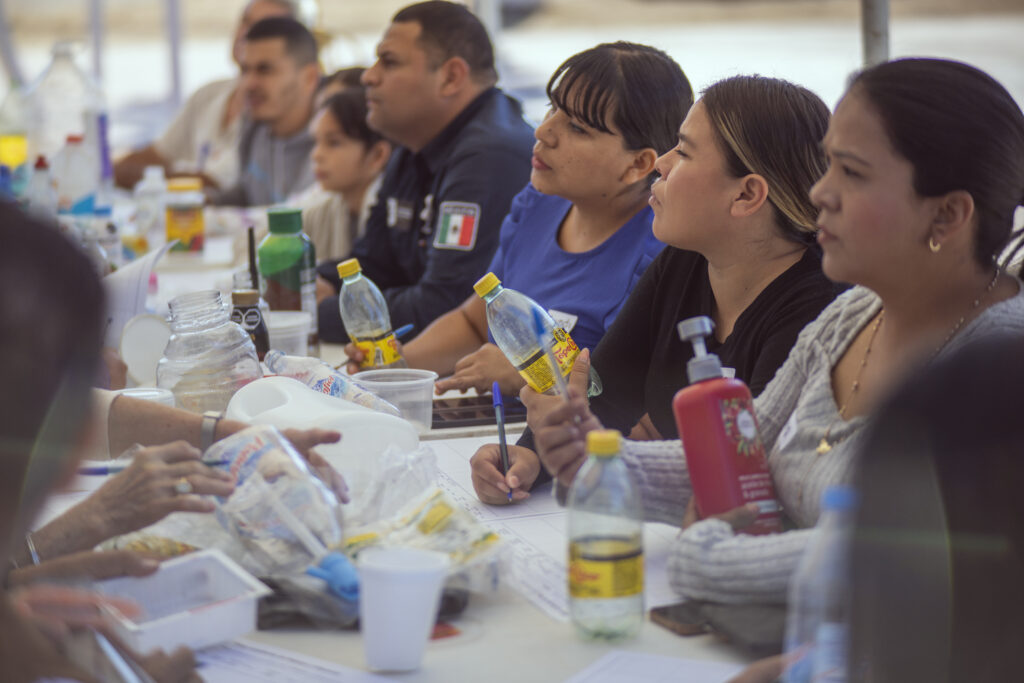
Beyond expanding physical infrastructure, the project adopts an evidence-based behavior change approach to address the factors that shape citizen participation. To better inform this process, surveys and focus groups are being conducted with current and potential users to explore motivations, barriers, and perceptions related to waste separation and recycling. The findings will be used to design a targeted Action Plan with practical measures aimed at making waste separation more convenient, socially supported, and easier to sustain over time. This replicable approach will enable the project to leverage knowledge, social norms, self-efficacy, and convenience to promote sustained and scalable adoption of proper waste management practices in urban areas.
Baseline Findings
Between July 2024 to December 2025, the 9 Metropolitan Green Collection Centers collected 41,941.45 kilos, or 41.941 tons, of which 4,574.52 kilos correspond to plastic (PET 1, HDPE 2, LDPE 4, PP5 and plastic bottle caps).
Household participation within the 800-meter service radius reached 6.9% (December 2025) of the total households in the area.
Results Report of the Metropolitan Area of Guadalajara
Target and Goals
- Increase Plastic recovery from a baseline of 4.57 tons (December 2025) by 10-fold by December 2026.
- Increase registered household participation within the 800m service radius from 6.9% (December 2025) to 28.86% in December 2026.